Choosing among cable crossover machines for home gyms comes down to fit, adjustability, and how much training variety you want from one station.
This roundup focuses on practical options that can support full-body strength work without wasting space or adding unnecessary complexity.
Best 10 Cable Crossover Machines for Home Gyms Picks for 2026
Wall-Mounted All-in-One Cable Station
WM1 17-Position Home Gym Cable Crossover

- Combines multiple cable training functions in one station.
- 17 pulley positions help with different exercise angles.
- Includes several attachments for immediate use.
Best For: Compact garage gyms needing an all-in-one wall-mounted cable station
Folding Power Rack Trainer
WM3-V4 Folding Rack with Dual Cable System

- Folding design saves space when not in use.
- Five modes combine rack and cable training.
- Dual pulleys support isolateral cable work.
Best For: Lifters who want a folding rack and cable crossover in one
Commercial-Grade Cable Crossover Station
Body-Solid PFT100 Dual-Stack Functional Trainer

- Dual 160 lb stacks support isolateral cable work.
- Wide exercise list covers full-body training.
- Heavy-duty frame is built for permanent gym use.
Best For: Users wanting a full-size, commercial-style home cable crossover
Dual-Mode Cable Station
Eonfit E1 2.0 Dual-Mode Cable Crossover

- Wall-mount or freestanding setup adds flexibility.
- 33 heights and 3D arms widen exercise options.
- 800 lb capacity and steel frame support heavy use.
Best For: Users wanting a flexible wall-mount or freestanding cable station
Heavy-Duty Full-Size Trainer
Body-Solid Best Fitness Functional Trainer

- High and low pulleys with 180°+ swivel movement
- Wide exercise menu for upper and lower body work
- 10-year frame warranty for long-term use
Best For: Dedicated home gyms that can handle a full-size cable station
Space-Saving Wall-Mounted Option

- Foldable wall-mounted design saves floor space
- 26 height holes and 13 arm angles
- Supports 2:1 and 1:1 cable ratios
Best For: Compact home gyms that need a wall-mounted, adjustable cable station
All-in-One Rack Combo
DP01 Power Cage with Cable Crossover

- Combines a power cage with dual cable crossover system
- 2:1 pulley ratio and independent pulleys
- Rated for up to 2000 pounds
Best For: Home lifters who want a rack, pulldown, and cable system in one unit
Wall-Mounted Space Saver
Mikolo Wall Mount Cable Station
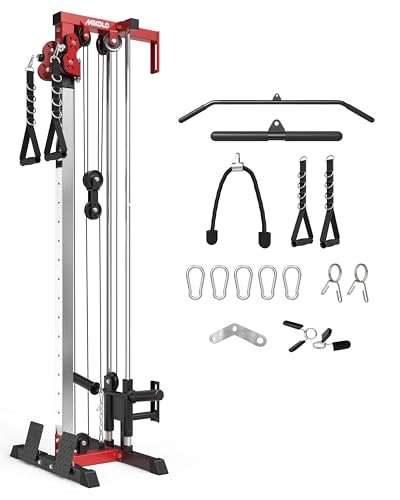
- Wall-mounted design saves floor space
- Dual pulleys with 19 height positions
- Includes lat bar, cable bar, and tricep rope
Best For: Compact home gyms that need a wall-mounted cable station
Triangular Trainer Build

- Triangular frame creates a 64-inch front training space
- 15 pulley height levels support many exercises
- Includes pull-down bar, rowing bar, and pull-up handles
Best For: Small home gyms that want a versatile functional trainer
Compact Functional Trainer

- Uses just 12.1 square feet of floor space
- Smooth PU-coated pulley system
- Includes pull-down, row, and pull-up accessories
Best For: Apartment or small-home buyers needing an all-in-one cable trainer
Wall-Mounted All-in-One Cable Station – WM1 17-Position Home Gym Cable Crossover
If you’re comparing cable crossover machines for home gyms and want maximum versatility in a small footprint, the WM1 is built to do a lot in very little space. This wall-mounted station combines high and low pulley work with a removable footplate, dual independent pulleys, and multiple included attachments so you can cover pressing, rowing, flys, curls, and pulldowns without adding extra machines.
Best For: Garage or home gym owners who want an all-in-one cable station with a compact wall-mounted design.
Pros:
- Combines several training stations, including lat pulldown, seated row, cable crossover, and bicep curl work.
- 17 height positions and dual independent pulleys help you dial in angles for different movements.
- Includes multiple attachments, so you can start training without extra purchases.
- Wall-mounted build is designed for tight spaces and a more stable feel.
Cons:
- Requires wall mounting, so it is less flexible than a freestanding setup.
- 300 lb maximum weight recommendation may limit heavier users or advanced lifters.
- Best suited to users comfortable with a fixed installation.
Overall, the WM1 stands out as a space-conscious way to add a lot of cable training variety to a home gym. It makes the most sense if you want a compact, multi-use machine rather than a simple crossover station.
Folding Power Rack Trainer – WM3-V4 Folding Rack with Dual Cable System
For buyers looking at cable crossover machines for home gyms with serious strength-training flexibility, the WM3-V4 adds a folding rack to a dual-pulley functional trainer. It gives you five modes, including folded storage, half rack, functional trainer, and cable crossover use, so it can support both barbell work and cable exercises in one space-saving design.
Best For: Home gym users who want a folding rack plus a cable crossover system in one unit.
Pros:
- Five workout modes let you switch between storage, rack work, and cable training.
- Dual independent pulleys support isolateral training, supersets, and partner workouts.
- 15 adjustable pulley heights add flexibility for rows, flys, and other cable movements.
- Folds down to a compact footprint, which is useful for apartments or garages.
Cons:
- More complex than a basic cable machine, so setup and installation will be more involved.
- Two-box delivery and assembly may take extra time and planning.
- The all-in-one design may be more than some users need if they only want cable exercises.
The WM3-V4 is a strong pick if you want one station that can handle lifting, pull-ups, and cable work without taking over the room. It is especially appealing when you need storage-friendly gear with broad training coverage.
Commercial-Grade Cable Crossover Station – Body-Solid PFT100 Dual-Stack Functional Trainer
If your search for cable crossover machines for home gyms leans toward a more traditional full-size functional trainer, the Body-Solid Powerline PFT100 is built around dual weight stacks and a wide range of cable exercises. Its extra-wide mainframe and isolateral design make it a practical choice for users who want dedicated resistance and a long list of movement options.
Best For: Home gym owners who want a full-size, dual-stack cable crossover machine with classic gym-style training.
Pros:
- Two 160 lb weight stacks provide dedicated resistance for each side.
- Dual independent stacks support true isolateral movements and varied training.
- Large exercise list covers chest, back, shoulders, arms, legs, and core work.
- Backed by a 10-year frame warranty and established brand history.
Cons:
- Large footprint and 476 lb machine weight require plenty of floor space.
- Less space-friendly than folding or wall-mounted alternatives.
- Designed more like a permanent gym fixture than a movable home machine.
The PFT100 makes the most sense for buyers who want a classic commercial-style cable station at home. It is not the smallest option, but it delivers a broad exercise range and a sturdy, no-nonsense build.
Dual-Mode Cable Station – Eonfit E1 2.0 Dual-Mode Cable Crossover
Among cable crossover machines for home gyms, the Eonfit E1 2.0 stands out for combining wall-mount and free-standing flexibility with 3D free-motion arms. It is designed for smaller training spaces and gives you a wide range of cable movements, from lat pulldowns and low rows to flys, triceps, biceps, squats, and deadlifts.
Best For: Home gym users who want a versatile dual-mode cable station with adjustable free-motion arms.
Pros:
- Can be wall mounted or used freestanding with base plate support.
- 33 height settings and 360-degree adjustable arms expand exercise variety.
- 2:1 strength ratio on the arms supports smoother lighter-load training.
- Stable steel construction and 800 lb capacity suit demanding workouts.
Cons:
- Freestanding use still needs space, despite the compact design.
- Heavier machine weight may make setup less convenient.
- Its feature set may be more advanced than a simple starter cable machine.
The E1 2.0 is a flexible option if you want a cable station that can adapt to different room layouts. It combines a broad exercise range with adjustable arms, making it especially useful for users who like varied cable training.
Heavy-Duty Full-Size Trainer – Body-Solid Best Fitness Functional Trainer
If you want cable crossover machines for home gyms that feel closer to a commercial setup, this Body-Solid trainer is built for broad exercise variety and smooth pulley movement. It combines high and low pulley work with a large exercise list, making it a strong fit for full-body training in a dedicated space.
Best For: Home gym owners who want a full-size, versatile cable station with lots of exercise options.
Pros:
- Offers high and low pulleys with over 180° of swivel movement for varied training angles.
- Supports a wide range of exercises, including pec flys, rows, pulldowns, presses, and lower-body moves.
- Built with patented nylon bushing technology and sealed ball bearing pulleys.
- Backed by a 10-year frame warranty and 1-year parts warranty.
Cons:
- Large footprint may be difficult to fit in smaller home gyms.
- Maximum weight recommendation is 133 pounds, which may limit heavier users.
- At 102 pounds, it is still a substantial piece of equipment to place and assemble.
This is a strong pick if you have the room for a dedicated cable station and want a traditional crossover-style trainer with broad movement options. It favors versatility and build quality over compactness.
Space-Saving Wall-Mounted Option – GMWD Cable Machine Home Gym
For buyers comparing cable crossover machines for home gyms in tighter spaces, this wall-mounted GMWD model stands out for its foldable design and adjustable arm settings. It delivers a broad exercise range while keeping the footprint much smaller than a freestanding commercial-style trainer.
Best For: Home gym users who need a compact, wall-mounted cable machine with flexible adjustments.
Pros:
- Wall-mounted, foldable design helps save floor space when not in use.
- Offers 100+ exercises, including flys, presses, curls, pulldowns, and woodchoppers.
- Dual swivel arms provide 26 height holes, 13 arm angle settings, and 180° motion.
- Includes accessories and wall-mounting hardware for wood and concrete surfaces.
Cons:
- Requires secure wall installation, so it is not ideal for every room setup.
- Assembly and mounting are more involved than a simple standalone unit.
- Maximum weight recommendation is 350 pounds, which may not suit every strength-training goal.
This is a practical choice if you want functional-trainer versatility without giving up valuable floor space. The adjustability and folding layout make it especially appealing for garages, apartments, and smaller training rooms.
All-in-One Rack Combo – DP01 Power Cage with Cable Crossover
If you want cable crossover machines for home gyms but also need a squat rack, this DP01 setup bundles multiple training stations into one compact frame. It combines a power cage, dual pulley system, lat pulldown, low row, and cable crossover functions for a more complete strength-training layout.
Best For: Lifters who want a power cage and cable system in one space-efficient unit.
Pros:
- Combines a full squat rack with functional trainer and cable crossover features.
- Dual independent pulley system supports unilateral work and partner training.
- 2:1 pulley ratio provides smooth motion for curls, pushdowns, and crossover moves.
- Heavy-duty 2″x2″ steel tubing supports up to 2000 pounds.
Cons:
- More complex than a standalone cable machine, so setup will take more planning.
- At 57.87″ deep and 84.25″ tall, it still needs meaningful floor and ceiling clearance.
- Best suited to users who will actually use the rack features, not just cables.
This is the most complete all-in-one option in the group if you want a serious home gym centerpiece. It makes the most sense for users who want both barbell lifting and cable training without buying separate stations.
Wall-Mounted Space Saver – Mikolo Wall Mount Cable Station
If you want cable crossover machines for home gyms without giving up floor space, the Mikolo Wall Mount Cable Station is built around that problem. Its wall-mounted layout, compact footprint, and corner-friendly design make it a practical pick for garage, home, or office setups, while the dual adjustable pulleys give you room to train both sides or one side at a time.
Best For: Home gym owners who want a compact wall-mounted cable station with versatile pulley positions.
Pros:
- Wall-mounted, space-saving design fits corners and smaller rooms
- Dual pulley system with 19 adjustable height positions
- Includes lat bar, cable bar, tricep rope, and adjustable strap handles
- Built from 14-gauge steel with a 400-pound max load rating
Cons:
- Requires wall installation, so it is not a freestanding solution
- Compact frame may feel less expansive than larger crossover towers
Overall, this is a strong choice if your priority is getting a full cable setup into a tight home gym. The combination of adjustable pulleys, included attachments, and sturdy build makes it easy to cover a lot of exercises in a small footprint.
Triangular Trainer Build – CC01 Cable Crossover Machine
Among cable crossover machines for home gyms, this CC01 functional trainer stands out for packing a broad exercise range into a relatively compact footprint. The triangular frame creates a 64-inch front training space, and the high-and-low pulley setup supports movements like seated rows, lat pulldowns, chest flyes, triceps pushdowns, and more.
Best For: Users who want a compact functional trainer with a large front training area and pull-up capability.
Pros:
- Triangular structure provides a spacious 64-inch front training zone
- 15 height adjustment levels for varied pulley exercises
- Commercial steel tubing and powder-coated finish for durability
- Includes pull-down bar, rowing bar, and pull-up handles
Cons:
- Assembly is recommended with 2-3 people
- Useful capacity depends on separate plate loading and system limits
This is a practical all-in-one option if you want one machine for rows, presses, pulldowns, and pull-ups. Its space-efficient footprint and included accessories make it especially appealing for smaller home gyms that still want a serious training setup.
Compact Functional Trainer – CC01 Cable Crossover Machine
If you are comparing cable crossover machines for home gyms, this CC01 model is aimed at users who want a full functional trainer without a huge footprint. It offers the same triangular, space-efficient layout, smooth pulley action, and multi-exercise versatility for rows, pulldowns, flyes, and pull-up work.
Best For: Home gym buyers who need a compact all-in-one cable machine with a broad exercise menu.
Pros:
- Space-efficient triangular design uses just 12.1 square feet
- Ultra-smooth pulley system with PU-coated steel cables
- 15 height adjustment levels for upper and lower cable work
- Includes pull-down bar, rowing bar, and pull-up handles
Cons:
- Assembly time is still around 1.5 hours with 2-3 people
- The product is very similar to the other CC01 listing, so shoppers may need to compare bundle details carefully
For a home gym that needs one machine to cover a wide range of cable movements, this setup checks a lot of boxes. The compact footprint and included accessories make it a sensible choice for apartments or smaller training rooms.
How We Picked the Best Cable Crossover Machines for Home Gyms
We prioritized machines that make sense for home use: stable frames, useful pulley ranges, realistic footprint requirements, and setup options that match garages, spare rooms, and basement gyms. We also looked for machines that offer enough exercise variety to justify the investment.
Quick Comparison
The main tradeoffs are usually wall-mounted versus free-standing designs, single-stack versus dual-pulley setups, and how much adjustment you get from the arms, pulleys, and attachments. Wall-mounted models can save floor space, while cage-style units often add more versatility for squat and cable work in one footprint.
Key Buying Factors for Cable Crossover Machines for Home Gyms
Space and Mounting
Measure ceiling height, wall width, and floor depth before buying. If your space is tight, a wall-mounted unit may be the better fit. If you want a more complete training hub, a rack-integrated option may be worth the extra room.
Pulley Adjustability
More adjustment positions usually mean better exercise angles for presses, flyes, rows, curls, triceps work, and lower-body movements. Look for smooth height changes and stable locking points rather than just a high number of settings.
Load Capacity and Resistance
Choose a machine that matches your current strength and future progress. Weight-stack systems are convenient, while plate-loaded designs can offer more flexibility. Either way, the machine should feel controlled under load and not flex excessively.
Training Versatility
A good cable crossover machine should support more than chest flyes. Consider whether you want pull-ups, lat work, single-arm training, core work, or lower-body accessories from the same station.
Who Should Buy Which Cable Crossover Machines for Home Gyms?
If you want maximum space efficiency, choose a wall-mounted model. If you want an all-in-one strength setup for squats and cables, a power rack with integrated pulleys is the smarter pick. If you prefer quick, low-fuss workouts, a weight-stack functional trainer will usually be the most convenient choice. For lifters building Cable Crossover Machines for Home Gyms around long-term use, prioritize stability, adjustability, and the exercises you will actually perform most often.