A free-standing pull-up bar can add vertical pulling, dips, knee raises, and core work to a home gym without requiring wall or ceiling installation. The right power tower should feel stable during demanding movements while fitting your available floor space.
We compared 10 popular options across construction, capacity, adjustability, portability, and exercise versatility to help you choose a station that matches your training style and budget.
Best 10 Free Standing Pull Up Bars Picks for 2026
Best Overall Family Tower

- 400-pound capacity with stability-focused hardware
- Nine height settings and adjustable armrests
- Supports a wide range of bodyweight exercises
Best For: Families sharing a versatile home workout station
Best Wide-Frame Option
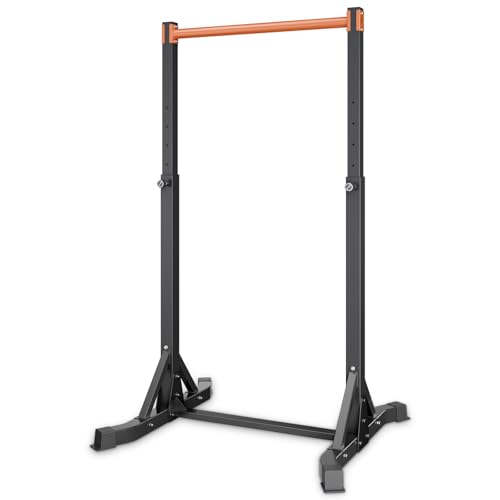
- 40.5-inch-wide frame supports multiple grips
- 330-pound capacity with reinforced carbon steel
- Eight height settings for family use
Best For: Grip variety and spacious leg-raise training
Best Height Adjustability
SogesPower Adjustable Dip Station

- 10 height levels for different users
- 330-pound capacity with H-shaped base
- Supports six full-body exercises
Best For: Families needing precise height adjustment
Best Comfort-Focused Design
SPORTSROYALS Compact Power Tower

- 360-pound capacity with a support-focused base
- Eight height and five backrest settings
- Ergonomic padding and non-slip grips
Best For: Comfortable, varied home strength workouts
Adjustable Home Pick

- Eight height settings from 59 to 85 inches
- Reinforced steel frame rated to 330 pounds
- Supports pull-ups and accessory training
Best For: Families and adjustable home-gym workouts
Space-Saving Choice

- Folds for easier storage after workouts
- 350-pound capacity and 11 height levels
- Combines pull-ups, dips, and leg raises
Best For: Compact home gyms needing versatile training
Heavy-Duty Standout

- 660-pound maximum load rating
- 2mm steel tubing with padded support
- Handles pull-ups, dips, push-ups, and raises
Best For: High-capacity strength training at home
Most Space-Saving

- 450-pound capacity with 2mm steel construction
- Folds to a compact 41.5-inch footprint
- Adjustable for multiple users and exercises
Best For: Families and apartment users needing a foldable, versatile station
Most Adjustable
SERTT Foldable Multi-Grip Power Tower
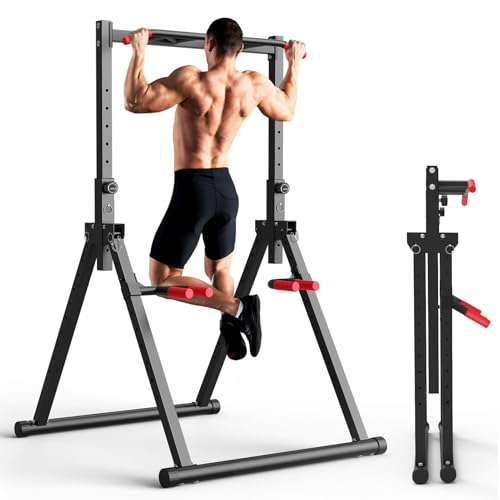
- Ten height and ten handle-position settings
- Five pull-up grips plus three dip widths
- 440-pound capacity and fold-flat design
Best For: Households sharing one highly customizable power tower
Best for Comfort
Dskeuzeew Adjustable Strength Tower
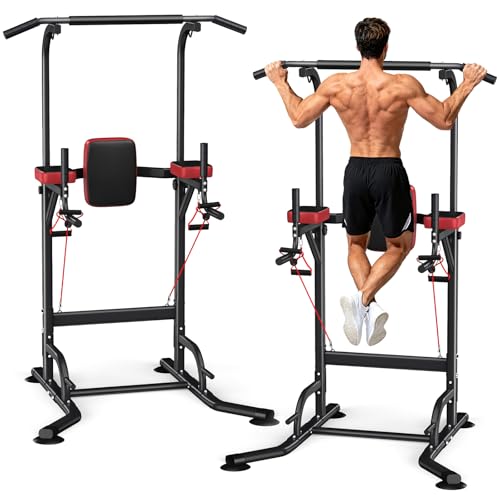
- 450-pound capacity with suction-cup H-base
- Thirteen height settings for varied users
- Padded armrests, back support, and foam grips
Best For: Comfort-focused users training at varied heights
Best Overall Family Tower – RELIFE Adjustable Power Tower
For shoppers comparing free standing pull up bars, the RELIFE power tower stands out as a versatile home-gym option with a 400-pound capacity, multiple height settings, and support for several bodyweight exercises. Its suction cups, safety locknut, and thick steel tubing are designed to improve stability during training.
Best For: Families wanting an adjustable station for pull-ups, dips, push-ups, rows, and knee raises.
Pros:
- Supports up to 400 pounds and includes four suction cups plus a safety locknut.
- Nine height settings and adjustable armrests accommodate different users.
- Supports pull-ups, chin-ups, dips, push-ups, rows, and vertical knee raises.
- Compact design and included assembly instructions suit home gyms with limited space.
Cons:
- Assembly requires ensuring that all screws are properly tightened.
- Its 43-pound frame may be less convenient to move than lighter portable stands.
Choose this model if broad adjustability and a higher stated weight capacity matter most. The multiple adjustments make it especially practical for shared household use.
Best Wide-Frame Option – VEVOR H-Frame Pull-Up Station
The VEVOR is a practical choice among free standing pull up bars if you want extra room for different grips and leg raises. Its 40.5-inch-wide frame, reinforced carbon steel tubes, and extended H-shaped base are designed to provide training space and ground stability.
Best For: Users who prioritize a wide workout area, adjustable height, and a relatively lightweight station.
Pros:
- The extra-wide frame supports wide, narrow, and neutral grips.
- Reinforced 1.5 mm carbon steel tubing supports up to 330 pounds.
- Eight height settings cover approximately 60.5 to 85.8 inches.
- Triangular bracing and an extended H-shaped base increase ground contact.
Cons:
- The listed capacity is lower than the RELIFE model in this roundup.
- Its broad footprint may require more floor space than compact towers.
VEVOR makes sense for users who want unrestricted grip positions without stepping up to a heavier commercial-style tower. The labeled parts and included instructions are also helpful for straightforward assembly.
Best Height Adjustability – SogesPower Adjustable Dip Station
The SogesPower power tower is worth considering when shopping for free standing pull up bars with extensive height adjustment. It offers 10 height levels, a long H-shaped base, larger suction cups, and exercise support for pull-ups, dips, knee raises, push-ups, and leg pressing.
Best For: Households that need many height positions and a full-body bodyweight training station.
Pros:
- Offers 10 height-adjustment levels from about 65 to 82.7 inches.
- Supports up to 330 pounds with a steel construction.
- Large suction cups and a 32.3-inch H-shaped base are designed for stability.
- Supports six listed movements, including pull-ups, dips, knee raises, and push-ups.
Cons:
- The instructions recommend using it on a flat concrete floor rather than carpet.
- Its stated dimensions and base may require dedicated floor space.
This is a strong fit when fine-grained height adjustment is more important than a minimal footprint. Place it on a suitable hard, flat surface to make the most of its suction-cup stability system.
Best Comfort-Focused Design – SPORTSROYALS Compact Power Tower
For buyers seeking free standing pull up bars with comfort-oriented features, the SPORTSROYALS power tower combines a 360-pound capacity with adjustable height and backrest positions. Its inclined armrests, padded support, non-slip grips, and compact design are intended to make varied home workouts more comfortable.
Best For: Users who want a compact, comfort-focused tower for pull-ups, dips, leg raises, rows, and push-ups.
Pros:
- Thickened commercial steel and a π-shaped base support a 360-pound load capacity.
- Eight height levels range from approximately 57.09 to 83.07 inches.
- Five backrest settings, thicker padding, inclined armrests, and non-slip grips enhance comfort.
- Supports 10-in-1 full-body training, including pull-ups, dips, rows, leg raises, and push-ups.
Cons:
- The listed 360-pound capacity is below the RELIFE tower’s 400-pound rating.
- Although described as compact, the tower still requires assembly and a stable setup area.
SPORTSROYALS is a compelling option if ergonomic support matters as much as exercise variety. Its adjustable backrest and arm-focused padding make it particularly appealing for longer, mixed-exercise sessions.
Adjustable Home Pick – Bongkim Power Tower
The Bongkim Power Tower is a practical option for shoppers comparing free standing pull up bars for a home gym. Its reinforced steel frame supports up to 330 pounds, while eight height settings make it suitable for different users and workout preferences.
Best For: Families or home-gym users who want adjustable pull-up training with room for accessory exercises.
Pros:
- Eight height positions from 59 to 85 inches.
- Reinforced triangular support structure and thickened steel tubing.
- Supports pull-ups and combinations using rings, sandbags, or hammocks.
- Assembly tools and instructions are included.
Cons:
- Its assembled footprint is relatively large at 43.5 by 38.58 inches.
- At 51.8 pounds, it may require effort to reposition.
Choose this station if adjustability is more important than a compact footprint. The 330-pound capacity and multiple attachment possibilities give it useful flexibility for home workouts.
Space-Saving Choice – YYJO Foldable Power Tower
The YYJO Foldable Power Tower stands out among free standing pull up bars for users who need to store equipment after training. Its triangular design folds down, offers 11 height adjustments, and combines pull-ups, dips, leg raises, and other bodyweight movements.
Best For: Smaller home gyms that need a foldable station with pull-up and dip functionality.
Pros:
- Foldable design reduces the stored footprint to 33.46 by 6.3 by 75.2 inches.
- 350-pound weight capacity with a 1.2mm thick steel tube frame.
- Eleven height settings from 68.9 to 82.68 inches.
- Offers pull-ups, dips, leg raises, chest work, and core exercises.
Cons:
- The listed assembled width is 51.2 inches, so it still needs substantial workout space when open.
- It has a narrower height range than some highly adjustable stations.
This is a strong fit when storage convenience matters. The foldable frame and broad exercise selection make it more versatile than a basic pull-up bar, provided you have enough room to unfold it safely.
Heavy-Duty Standout – DONIUZ Power Tower
The DONIUZ Power Tower is designed for shoppers seeking heavy-duty free standing pull up bars. Its 2mm steel tubing is rated for up to 660 pounds, and the station adds back support, elbow pads, multiple pull-up handles, and adjustable height for a broader strength-training routine.
Best For: Users prioritizing high load capacity and a padded multi-exercise power tower.
Pros:
- 660-pound maximum load rating with 2mm thick steel tubing.
- Adjustable height from 74.8 to 87 inches.
- Supports pull-ups, dips, push-ups, and leg or knee raises.
- Backrest and elbow pads are designed for added comfort and support.
Cons:
- The 32 by 41 inch footprint requires dedicated floor space.
- Assembly is required, and the unit weighs substantially enough to be difficult to move.
- The manufacturer recommends use on a flat concrete floor rather than carpet.
The DONIUZ is the most heavy-duty option in this group on paper. Its high capacity and supportive padding suit demanding workouts, while the floor-surface recommendation is important to consider before buying.
Most Space-Saving – Foldable 450-Lb Power Tower
For shoppers comparing free standing pull up bars, the JOROTO stands out with a foldable frame, substantial weight capacity, and broad height adjustability. It combines pull-ups, dips, knee raises, and push-ups in one home-gym station, while leveling knobs help improve stability on uneven floors.
Best For: Families or apartment users who want a versatile, foldable station with a high 450-pound capacity.
Pros:
- Supports up to 450 pounds with a heavy-duty 2mm steel frame.
- Folds to a compact 41.5-inch footprint for storage or transport.
- Offers four pull-up height levels, seven dip-bar adjustments, and a built-in kids’ bar.
- Supports pull-ups, chin-ups, dips, knee raises, and push-ups.
Cons:
- The 29.48-kilogram frame may still require meaningful effort to move.
- Full stability depends on properly adjusting the leveling knobs and tightening the bolts.
The JOROTO is a strong all-around choice when storage flexibility and family adjustability matter as much as workout variety. Its foldable design is especially useful in smaller rooms, garages, or multipurpose spaces.
Most Adjustable – SERTT Foldable Multi-Grip Power Tower
The SERTT is a compelling option among free standing pull up bars for households with different users and training preferences. Its triangular foldable base, numerous height and handle settings, five pull-up grips, and tool-free dip-handle adjustment make it adaptable for varied strength workouts.
Best For: Multi-user homes and trainees who want extensive grip, height, and dip-position customization.
Pros:
- Supports up to 440 pounds with thickened 2mm steel tubing.
- Provides 10 pull-up height settings and 10 dip/push-up handle positions.
- Includes five pull-up grips and three dip-handle width options.
- Folds flat and is designed for assembly in about 20 minutes.
Cons:
- Its 440-pound capacity is slightly lower than some 450-pound alternatives.
- The many adjustment options may take more setup time when switching users or exercises.
Choose the SERTT if adjustability is your priority. The wide 39.4-inch design and extensive grip selection support varied movements, while the foldable frame helps make the station easier to store between sessions.
Best for Comfort – Dskeuzeew Adjustable Strength Tower
Among free standing pull up bars, the Dskeuzeew focuses on supported training and user comfort. Its H-base uses suction cups for stability, while foam grips, padded armrests, and a back cushion complement adjustable pull-up and dip positions for teens and adults.
Best For: Users who want a padded, height-adjustable station for pull-ups, dips, knee raises, rows, and push-ups.
Pros:
- Supports up to 450 pounds and includes industrial-strength suction cups.
- Offers 13 height settings from 72 to 87.8 inches.
- Includes padded arm and back supports with high-density foam and PU leather.
- Combines pull-up, dip, push-up, and rope-training features in one station.
Cons:
- The suction-cup base may be most effective on suitable smooth flooring.
- The station’s height range and overall footprint should be checked against the available room.
- Assembly requires careful tightening of all screws.
The Dskeuzeew is a practical pick for comfort-focused home workouts. Its padding and 13-position height adjustment make it especially appealing to users who want a more supported setup rather than a minimalist pull-up frame.
How We Picked the Best Free Standing Pull Up Bars
We focused on the features that matter most in a home power tower: frame stability, stated weight capacity, height adjustment, footprint, foldability, padding, grip options, and the range of supported exercises. We also considered whether each design is practical for apartments, shared spaces, or dedicated home gyms. Capacity figures are manufacturer claims, so users should follow the supplied assembly, placement, and safety instructions.
Quick Comparison
| Best For | Look For |
|---|---|
| Overall home use | Stable H-frame, padded supports, and multiple exercise stations |
| Small spaces | Foldable frame and a manageable storage footprint |
| Heavy users | Higher stated capacity, broad base, and reinforced steel construction |
| Beginners | Adjustable height and compatibility with assistance bands |
| Advanced training | Rigid construction, dip handles, and enough clearance for knee raises |
Key Buying Factors for Free-Standing Pull-Up Bars
Stability and Construction
A wide, well-braced base helps limit rocking and tipping during pull-ups, dips, and swinging movements. Heavy-duty steel can improve confidence, but frame geometry and secure assembly matter just as much as advertised capacity. Place the tower on a level, non-slip surface and check all fasteners regularly.
Height and User Fit
Choose a pull-up height that lets you hang without your knees contacting the floor while still leaving adequate ceiling clearance. Adjustable models suit multiple users, but confirm their lowest and highest settings before buying. Taller athletes may need extra clearance for a full range of motion.
Exercises and Accessories
Most stations support pull-ups, chin-ups, dips, push-ups, and leg or knee raises. Assistance bands can make progression easier, while padded back and elbow supports improve comfort during core exercises. If you plan muscle-ups or kipping, verify that the manufacturer specifically supports dynamic use; many home towers are intended for controlled movements.
Storage and Assembly
Foldable free-standing pull-up bars are useful when floor space is limited, but folding hardware adds another component to inspect. Measure the assembled and folded dimensions, doorways, and ceiling height. Allow time for careful assembly, since a slightly misaligned frame can affect stability.
Who Should Buy Which Free Standing Pull Up Bars?
Choose a broad, heavily braced power tower if stability is your top priority or multiple people will use it. A foldable model is the better fit for apartments, multipurpose rooms, and anyone who needs to store equipment after training. Adjustable stations are practical for households with users of different heights and for beginners who want to combine assisted and unassisted work. If your routine centers on pull-ups, dips, and controlled core exercises, a straightforward tower may offer better value than a larger station with unused attachments. Finally, compare the listed capacity, footprint, warranty, and return policy—not just the number of included functions—before making your decision.