The best heart rate monitor with Bluetooth can deliver more responsive, workout-ready data than many wrist-based trackers. Chest straps typically prioritize accuracy, while optical armbands offer greater comfort and flexibility.
We compared 10 popular Bluetooth and ANT+ models across sensor design, connectivity, water resistance, battery life, and compatibility to help you choose the right monitor for your training setup.
Best 10 Heart Rate Monitor with Bluetooth Picks for 2026
Most Accurate Chest Strap

- Highly accurate heart rate readings
- Bluetooth and ANT+ connectivity
- Waterproof with up to 400-hour battery life
Best For: Athletes seeking precise, flexible chest-strap monitoring
Best for Data-Driven Training

- Real-time heart rate and HRV data
- Advanced running dynamics support
- Records workouts without a watch
Best For: Garmin athletes who want detailed training metrics
Best Armband Alternative

- Comfortable adjustable armband design
- Bluetooth and ANT+ connectivity
- IP68 waterproof construction
Best For: Runners and gym users who prefer an armband
Best Long-Battery Option

- Up to one year of battery life
- Real-time heart rate and HRV data
- Machine-washable, 3 ATM-rated strap
Best For: Everyday Garmin users who prioritize low maintenance
Long-Battery Connectivity Pick

- ANT+ and Bluetooth compatibility
- 800-hour replaceable battery
- IP67 water resistance
Best For: Multi-device training with minimal battery maintenance
Trusted Accuracy Choice
- Polar high-accuracy sensors
- Works with compatible equipment
- Two-year manufacturer warranty
Best For: Everyday app-connected training
Comfort-Focused Training Pick
- Bluetooth and ANT+ connectivity
- Soft, seamless anti-chafe strap
- Sweatproof and water resistant
Best For: Long workouts across multiple training platforms
Best Overall Armband

- Dual Bluetooth and ANT+ connectivity
- Upper-arm, forearm, or goggle placement
- Live broadcasting or workout recording
Best For: Multi-sport training and swimmers wanting flexible placement
Best Long-Battery Chest Strap
- Up to 300 hours of battery life
- Bluetooth and ANT+ transmission
- IP67 waterproof construction
Best For: Frequent training with minimal battery maintenance
Best for Heart-Rate Zones

- Five-color zone indicator and vibration alert
- Bluetooth 5.0, dual Bluetooth, and ANT+
- Up to 35 hours of rechargeable battery life
Best For: Zone-focused running, cycling, and fitness workouts
Most Accurate Chest Strap – Polar H10
If accuracy is your priority, the Polar H10 is a strong heart rate monitor with Bluetooth for pairing with smartphones, tablets, computers, compatible equipment, and other devices. Its chest strap design, simultaneous Bluetooth and ANT+ connectivity, waterproof construction, and internal memory make it versatile for varied training setups.
Best For: Athletes who want highly precise readings, broad device compatibility, and a waterproof chest strap.
Pros:
- Recognized for highly accurate heart rate measurements.
- Supports Bluetooth, ANT+, and 5 kHz connections, including two simultaneous Bluetooth connections.
- Waterproof design with internal memory for multiple hours of data.
- Battery lasts up to 400 hours.
Cons:
- Chest straps may feel less convenient than armband-style monitors for some users.
- Requires a CR2025 button-cell battery.
The Polar H10 is a particularly well-rounded choice when dependable accuracy and flexible connectivity matter more than having a display or watch-style form factor.
Best for Data-Driven Training – Garmin HRM 600
The Garmin HRM 600 is a heart rate monitor with Bluetooth-oriented app compatibility and a strong focus on training data. It sends real-time heart rate and HRV information to compatible Garmin devices, fitness equipment, and apps, while also recording workouts when wearing a watch is impractical.
Best For: Garmin users, runners, and athletes who want heart rate, HRV, and advanced running-dynamics data.
Pros:
- Provides real-time heart rate and HRV data to compatible devices and apps.
- Tracks running metrics such as stride length, vertical oscillation, and ground contact time balance with a compatible smartwatch.
- Can record workouts without a watch and sync data to Garmin Connect.
- Rechargeable battery provides up to two months of use.
Cons:
- Some advanced running features require a compatible Garmin smartwatch.
- Its feature set may be more than casual users need.
Choose the HRM 600 if you want a performance-focused sensor that extends Garmin’s training ecosystem beyond basic heart rate tracking.
Best Armband Alternative – Scosche Rhythm+ 2.0
The Scosche Rhythm+ 2.0 is a comfortable heart rate monitor with Bluetooth for users who prefer an armband over a chest strap. Its optical sensor pairs through Bluetooth or ANT+, supports HRV data in compatible apps, and is designed for workouts ranging from running and cycling to gym sessions.
Best For: Users who want a lightweight, adjustable armband with Bluetooth and ANT+ compatibility.
Pros:
- Adjustable fit works on the forearm, bicep, or tricep.
- Pairs with Bluetooth and ANT+ devices, fitness equipment, and apps.
- IP68 waterproof construction handles sweat, rain, and demanding workouts.
- Offers up to 24 hours of continuous battery life and HRV mode.
Cons:
- Twenty-four-hour battery life is shorter than the battery life of several chest-strap alternatives.
- Optical armband readings may not suit buyers specifically seeking a chest-strap design.
The Rhythm+ 2.0 is a practical pick for athletes who find chest straps restrictive and want broad app compatibility in a lightweight wearable.
Best Long-Battery Option – Garmin HRM 200
The Garmin HRM 200 is a straightforward heart rate monitor with Bluetooth compatibility for Garmin smartwatches, cycling computers, fitness equipment, apps, and smartphones. It focuses on accurate heart rate and HRV transmission, with a machine-washable strap and a user-replaceable battery rated for up to one year.
Best For: Users who want reliable Garmin-compatible heart rate and HRV tracking with minimal battery maintenance.
Pros:
- Transmits real-time heart rate and HRV data to compatible devices and apps.
- Offers up to one year of battery life with a user-replaceable battery.
- Machine-washable strap simplifies regular cleaning.
- Has a durable 3 ATM water rating.
Cons:
- It does not offer the advanced workout recording and running-dynamics features listed for the HRM 600.
- Chest-strap construction may not appeal to users who prefer an armband.
The HRM 200 makes sense for everyday training when long battery life, basic HRV support, and easy strap maintenance are more important than expanded performance features.
Long-Battery Connectivity Pick – GEOID HS500
If you want a heart rate monitor with Bluetooth for workouts across phones, watches, bike computers, and fitness equipment, the GEOID HS500 offers broad connectivity and a replaceable battery. Its chest-strap design is suited to running, cycling, fitness, football, and similar activities.
Best For: Athletes who want ANT+/Bluetooth compatibility and very long battery life.
Pros:
- Supports both ANT+ and Bluetooth connections for numerous devices and apps.
- 800-hour replaceable CR2032 battery life helps reduce maintenance.
- IP67 water resistance and movement-focused algorithms support demanding workouts.
- LED feedback confirms readiness and connection.
Cons:
- Swimming is not recommended.
- Bluetooth pairing should be completed through the app rather than directly through the phone settings.
The HS500 is a practical choice when cross-device compatibility and low-maintenance operation matter most. Its one-year limited warranty adds useful purchase support.
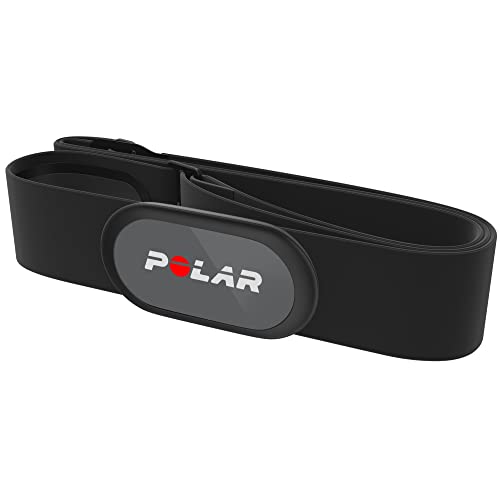
Trusted Accuracy Choice – Polar H9
Polar H9 Heart Rate Sensor – ANT + / Bluetooth - Waterproof HR Monitor with Soft Chest Strap, M-XXL
Check Price On AmazonThe Polar H9 is a straightforward heart rate monitor with Bluetooth for everyday training and app-based tracking. It combines Polar’s established heart-rate sensor technology with compatibility across heart-rate-enabled equipment and popular smartphone apps.
Best For: Everyday users seeking a reputable chest-strap heart-rate sensor with broad equipment compatibility.
Pros:
- Designed around Polar’s high-accuracy heart-rate sensors.
- Works with all heart-rate-monitor-compatible equipment, according to the supplied product information.
- Connects with popular smartphone apps to help turn a phone into a tracker.
- Includes a soft strap and a two-year manufacturer warranty.
Cons:
- Its CR2025 battery is rated for 400 hours, shorter than the HS500’s stated battery life.
- The supplied information does not list IP water-resistance details.
The H9 focuses on dependable heart-rate tracking and a familiar Polar ecosystem rather than extra status lights or unusually long battery life. It is a sensible fit for routine workouts and app-connected training.
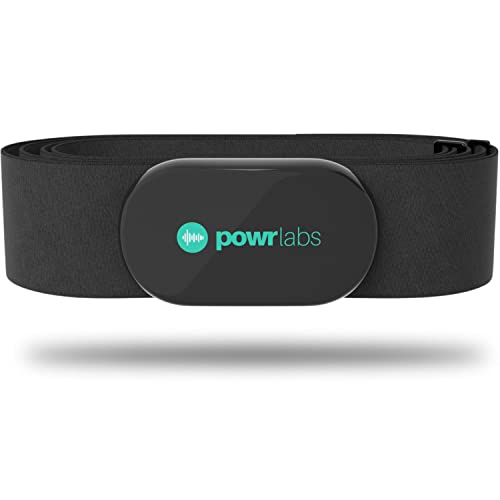
Comfort-Focused Training Pick – POWR LABS Chest Strap
For shoppers comparing a heart rate monitor with Bluetooth for cycling, gym sessions, or connected equipment, the POWR LABS chest strap emphasizes dual-band connectivity and comfort. It pairs with Garmin, Peloton, Wahoo, Polar, smartwatches, cycling computers, and more than 400 fitness apps.
Best For: Long training sessions requiring a soft, adjustable strap and wide device compatibility.
Pros:
- Dual Bluetooth and ANT+ connectivity supports a wide range of devices and apps.
- Soft, seamless fabric is designed to reduce chafing and slipping.
- Adjustable strap fits 24–61 inches, as stated in the product notes.
- IPX67 sweatproof and water-resistant construction is intended for demanding sessions.
Cons:
- Battery life is stated as more than 400 hours, so it requires more frequent replacement than the HS500.
- The strap must be worn before pairing.
The POWR LABS model stands out for comfort and compatibility, making it appealing for athletes who train frequently with several platforms. Its included replaceable battery avoids charging cables.
Best Overall Armband – Polar Verity Sense
Polar Verity Sense - Optical Heart Rate Monitor Armband - ANT+, Dual Bluetooth, Black, S-L
Check Price On AmazonThe Polar Verity Sense is a versatile heart rate monitor with bluetooth for athletes who prefer an armband over a wrist device or chest strap. Its optical sensor can broadcast live heart rate or record a workout for later transfer, while ANT+ and dual Bluetooth support make it useful with phones, tablets, computers, and compatible apps.
Best For: Swimmers, runners, and multi-sport users who want flexible placement and broad connectivity.
Pros:
- Comfortable upper- or lower-arm placement keeps the wrist free.
- Supports two simultaneous Bluetooth channels and unlimited ANT+ connections.
- Includes a swimming goggle clip for added versatility.
- Can broadcast live data or record sessions for later syncing.
Cons:
- Requires a connected device or app for viewing live heart rate.
- Armband sizing is listed as S-L, so fit should be checked before purchase.
Choose the Verity Sense if comfort, placement flexibility, and connection options matter more than having a built-in display. Its small, lightweight design and included accessories make it a strong all-around option for varied training.
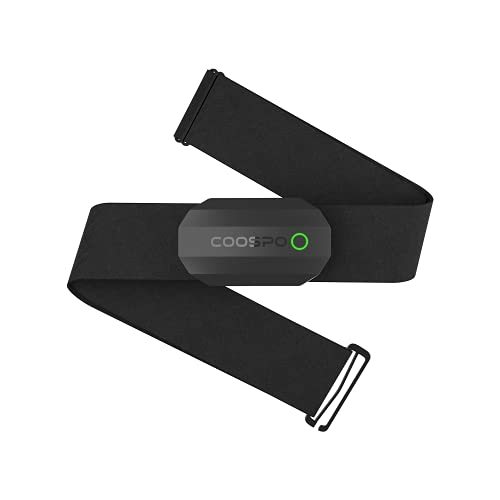
Best Long-Battery Chest Strap – COOSPO H808S Chest Strap
The COOSPO H808S is a heart rate monitor with bluetooth built around a chest strap for real-time exercise tracking. It combines Bluetooth 4.0 and ANT+ transmission, supports numerous fitness apps and devices, and uses a replaceable CR2032 battery rated for up to 300 hours.
Best For: Cyclists, runners, and indoor-training users who prioritize long battery life and chest-strap readings.
Pros:
- Uses Bluetooth and ANT+ to connect with compatible watches, bike computers, and apps.
- Offers a claimed accuracy of ±1 BPM during exercise monitoring.
- Replaceable battery provides up to 300 hours of average battery life.
- IP67 waterproof design suits exercise conditions.
Cons:
- The electrode zones should be moistened before use.
- The chest strap is recommended for replacement after six months or 300 washes.
- Setup requires pairing the sensor inside the app rather than through the phone’s general Bluetooth menu.
The H808S is a practical choice for consistent training data without frequent charging. Its chest-strap format may feel less convenient than an armband, but the long-lasting replaceable battery is useful for regular workouts.
Best for Heart-Rate Zones – COOSPO HW9 Optical Armband
The COOSPO HW9 is a heart rate monitor with bluetooth that combines an optical armband sensor with visual heart-rate zones and vibration alerts. Bluetooth 5.0 and ANT+ support connections to compatible apps, watches, and cycling computers, while the rechargeable battery provides up to 35 hours of use.
Best For: Runners, cyclists, and fitness users who want quick heart-rate-zone feedback during training.
Pros:
- Five-color LED indicator shows heart-rate zones at a glance.
- Supports two simultaneous Bluetooth connections plus ANT+.
- Offers customizable maximum heart rate settings and vibration alerts.
- Rechargeable battery lasts up to 35 hours and includes a magnetic charger.
Cons:
- Battery life is shorter than a replaceable-battery chest strap’s stated runtime.
- Live data and configuration depend on compatible apps or connected devices.
- The supplied notes list a small size, so fit should be confirmed.
The HW9 is especially appealing for zone-based workouts because its LED colors and vibration warning provide feedback without requiring constant screen checks. Select it over a chest strap if an adjustable optical armband feels more comfortable for your training.
How We Picked the Best Heart Rate Monitor with Bluetooth
We focused on monitors that support Bluetooth, with ANT+ compatibility included where available for connecting to watches, bike computers, gym equipment, phones, and training apps. We also considered sensor style, advertised battery life, water resistance, fit options, and whether each model suits steady workouts, interval training, or multi-sport use.
Because real-world accuracy depends on fit, skin contact, movement, and device compatibility, specifications should be treated as useful comparisons rather than guarantees. Chest straps generally provide the quickest response during hard efforts, while armbands can be easier to wear throughout the day.
Quick Comparison
| Type | Best For | Main Advantage | Potential Trade-Off |
|---|---|---|---|
| Chest strap | Running, cycling, intervals | Fast, responsive readings | Requires snug placement |
| Optical armband | Comfort and flexible placement | No chest band | May respond less quickly to sudden changes |
| Dual Bluetooth/ANT+ | Multi-device training | Broad compatibility | Usually costs more than basic Bluetooth models |
Key Buying Factors for a Heart Rate Monitor with Bluetooth
Connection Compatibility
Check whether your watch, phone, bike computer, treadmill, or training platform uses Bluetooth, ANT+, or both. Dual-band support is especially useful if you switch between a phone and dedicated fitness equipment.
Chest Strap or Armband
Choose a chest strap if immediate heart-rate changes matter for intervals, racing, or structured training. An optical armband may be preferable if chest straps feel restrictive or you want a simpler fit. Confirm the sensor’s supported placement and whether the strap or band is adjustable and washable.
Battery and Water Resistance
Long battery life reduces maintenance, but also check whether the unit uses a replaceable coin cell, rechargeable battery, or sealed design. For sweaty workouts and outdoor use, look for a suitable water-resistance rating; IP67 and waterproof claims are not necessarily interchangeable with full swim support.
App and Workout Features
Some sensors only broadcast heart rate, while others store workouts, estimate zones, or provide extra metrics. If you train without carrying a phone or watch, onboard memory can be valuable.
Who Should Buy Which Heart Rate Monitor with Bluetooth?
Choose a premium chest strap if accuracy and rapid response are your priorities for serious running, cycling, or interval work. Choose a basic Bluetooth/ANT+ chest strap for reliable gym and app connectivity at a lower cost. Choose an optical armband if comfort, easy placement, or avoiding a chest band matters most. Choose a dual-band model if you regularly connect to several devices or training platforms.
Before buying, verify device support, sensor placement, included strap size, battery type, and the manufacturer’s water-resistance guidance. The best Heart Rate Monitor with Bluetooth is the one that stays comfortable enough to wear consistently and connects cleanly to the equipment you already use.