Training recovery does not have to end when you leave the gym. The best infrared saunas for athletes can add convenient heat sessions to a broader routine that includes hydration, mobility work, sleep, and medical guidance when needed.
This roundup compares 10 home and portable models across capacity, heater design, red-light features, controls, power requirements, and setup. Use the guide below to narrow the options based on your space, training schedule, and recovery priorities.
Best 10 Infrared Saunas for Athletes Picks for 2026
Compact Recovery Pick
DYNAMIC Elite 1-Person Infrared Sauna

- Four low-EMF carbon heating panels
- Red light and chromotherapy lighting
- Clasp-together cedar construction
Best For: Solo recovery sessions in compact indoor spaces
Fast-Heating Value
DWKWE 1-Person Far Infrared Sauna

- Heats in about 10–15 minutes
- 60°F–140°F temperature adjustment
- 1–90-minute session timer
Best For: Customizable post-workout sessions on a busy schedule
Roomier Recovery Choice
Dynamic Barcelona 1-2 Person Sauna

- Six low-EMF carbon heating panels
- Fits one or two adults
- Includes red light and chromotherapy
Best For: Shared sessions or spacious solo recovery
Lightweight Space-Saver
Albott 1-Person Infrared Sauna

- Dedicated foot-zone heating
- Fits in about 6 square feet
- 107-pound modular design
Best For: Small home gyms and easy indoor installation
Best Full-Spectrum Pick

- Near-, mid-, and far-infrared heating
- Two-person hemlock cabin
- Red light therapy and Bluetooth audio
Best For: Athletes seeking a permanent two-person sauna with broad infrared coverage.
Best Portable Two-Person Option

- Fits two adults with folding chairs
- 660nm red and 850nm near-infrared lights
- Collapsible five-layer insulated enclosure
Best For: Athletes needing a portable two-person setup for a home gym or indoor space.
Best Feature-Packed Cabin
X-Vcak 1-2 Person Infrared Sauna

- Six heating panels and 150°F maximum
- Red and seven-color therapy lighting
- Bluetooth, radio, storage, and ventilation
Best For: Athletes wanting a compact cabin with adjustable sessions and entertainment features.
Best Low-EMF Pick
Cedarluma Red Light Infrared Sauna
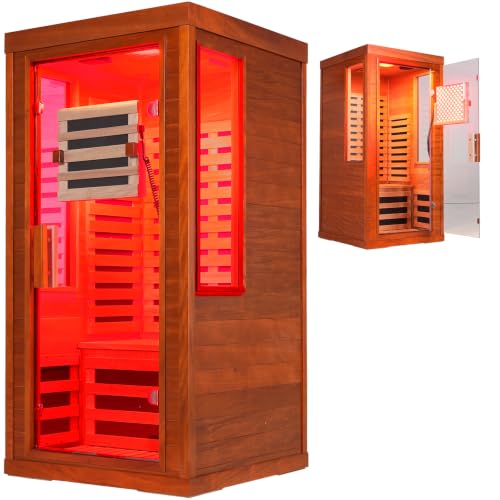
- Seven carbon-fiber panels deliver even heat
- 660nm and 850nm red/NIR light included
- Solid hemlock build with stated 1.4–2.6mG EMF
Best For: Athletes wanting a durable, low-EMF home sauna with red light therapy
Best Two-Person Steam Option
Portable Sauna Box with Red Light

- Two 1200W steamers with 15 temperature levels
- Spacious two-person enclosure with two chairs
- 660nm and 850nm LED panel with foldable design
Best For: Athletes wanting shared steam sessions and portable storage
Compact Recovery Pick – DYNAMIC Elite 1-Person Infrared Sauna
For athletes comparing infrared saunas for athletes, the DYNAMIC Elite is a compact indoor option with far-infrared heat, red light therapy, and low-EMF carbon panels. Its one-person design suits dedicated recovery sessions without requiring a large room.
Best For: Solo post-workout relaxation, compact home setups, and athletes who want red light therapy alongside infrared heat.
Pros:
- Four Carbon PureTech ultra-low-EMF heating panels support even heat circulation.
- Red light therapy and chromotherapy lighting add flexibility to recovery and relaxation routines.
- Clasp-together Pacific clear cedar construction is designed for relatively simple assembly.
- Includes Bluetooth audio, a built-in speaker, and a 5-year limited indoor-use warranty.
Cons:
- The interior is sized for one person only.
- Its recommended operating range is 118°F to 132°F, with a maximum of 140°F, which may feel modest to users seeking traditional sauna temperatures.
- The music system has no radio.
This sauna is a practical fit when space and straightforward setup matter most. Athletes wanting a compact recovery station with built-in lighting features should find its feature set well balanced.
Fast-Heating Value – DWKWE 1-Person Far Infrared Sauna
The DWKWE sauna is a useful choice for athletes seeking infrared saunas for athletes with adjustable sessions and quick warm-up. Its carbon fiber panels are designed to heat the cabin in about 10–15 minutes, while the timer and temperature controls support customized routines.
Best For: Athletes and busy professionals who prioritize rapid heating, adjustable sessions, and post-workout muscle-tension relief.
Pros:
- 1350W carbon fiber heating panels are designed for rapid, energy-efficient heating.
- Temperature adjusts from 60°F to 140°F, with a 1–90-minute timer.
- Natural hemlock construction supports heat retention and a spa-like indoor setup.
- Pre-drilled panels simplify DIY assembly.
Cons:
- The cabin is designed for one person.
- It has a larger footprint than some compact one-person models, measuring 35.4 by 29.7 by 67 inches.
- The notes do not specify a warranty or additional lighting and audio features.
With a broad adjustment range and quick stated heating time, this model emphasizes convenience over extra entertainment features. It is worth considering for athletes who want a customizable sauna routine that is easy to schedule around training.
Roomier Recovery Choice – Dynamic Barcelona 1-2 Person Sauna
For households or training spaces looking at infrared saunas for athletes, the Dynamic Barcelona offers more room than a solo cabin while retaining infrared-focused features. Its six low-EMF carbon panels, red light therapy, and standard 120-volt plug make it a versatile indoor recovery option.
Best For: Athletes who want to share a sauna session or prefer extra interior space for solo recovery.
Pros:
- Six carbon PureTech panels provide 360° infrared heating and are designed for efficient warm-up.
- The 1–2-person layout offers a roomier 36-by-32-by-67-inch interior.
- Red light therapy, chromotherapy, and an optional reading light support varied relaxation routines.
- Assembles in about one hour and uses a standard 15-amp, 120-volt plug.
Cons:
- At 250 pounds, it is substantially heavier and less portable than compact models.
- The recommended comfort range is 115°F to 130°F, with operation up to 135°F.
- Its larger design requires more floor space than a one-person sauna.
The Barcelona is a strong fit when comfort and capacity matter more than minimizing the footprint. Its heating coverage and lighting features make it especially appealing for shared wellness spaces or athletes who want room to stretch out.
Lightweight Space-Saver – Albott 1-Person Infrared Sauna
The Albott is a compact option for athletes comparing infrared saunas for athletes and working with limited indoor space. It combines four carbon panels with dedicated foot-zone heating, a roof vent, and a modular design that is intended to be assembled by one person.
Best For: Home gyms, apartments, and athletes who want foot warmth and a lightweight sauna that is easy to install.
Pros:
- Four carbon infrared panels provide full-body warmth with additional foot heating.
- Its approximately 6-square-foot footprint suits smaller rooms.
- At 107 pounds, the sauna is relatively lightweight, and setup is designed to take about 20 minutes.
- Finnish spruce, tempered glass, a door seal strip, and a roof vent support a durable, ventilated enclosure.
Cons:
- The one-person interior is not suitable for shared sessions.
- The product notes indicate that winter preheating can take longer and may reach up to 149°F.
- The compact dimensions may feel restrictive for taller or larger users.
This model stands out for athletes who value easy handling and a small footprint. Its foot-heating feature adds a recovery-focused touch, while the modular construction helps simplify indoor installation.
Best Full-Spectrum Pick – Santorini Full Spectrum Sauna
For athletes comparing infrared saunas for athletes, the DYNAMIC SAUNAS Santorini stands out with near-, mid-, and far-infrared heat in a spacious two-person cabin. Its indoor-friendly setup, red light therapy, and 140°F maximum temperature make it a practical option for post-workout relaxation at home.
Best For: Athletes who want a permanent, two-person full-spectrum sauna with integrated red light therapy.
Pros:
- Full-spectrum near-, mid-, and far-infrared heating.
- Two-person interior with natural Canadian hemlock construction.
- Red light therapy, Bluetooth, MP3 connectivity, speakers, and reading light.
- Assembles in about one hour and uses a standard 120-volt, 15-amp plug.
Cons:
- Designed for indoor use only.
- Its 140°F maximum may be lower than some traditional sauna temperatures.
- The cabin-style design is less portable than a sauna tent.
The Santorini is a strong fit when you prioritize a roomy, feature-rich home setup over portability. Its five-year limited warranty and straightforward electrical requirements add practical appeal for a dedicated wellness space.
Best Portable Two-Person Option – KASUE Portable Infrared Sauna
The KASUE portable model is worth considering among infrared saunas for athletes who need flexible storage or a setup for a home gym. It combines a two-person enclosure with 660nm red and 850nm near-infrared lights, dual 3-liter steam generators, folding chairs, and remote control operation.
Best For: Athletes who need a portable, collapsible sauna setup that can accommodate two adults.
Pros:
- Spacious 71-by-49-by-36-inch enclosure with two folding chairs.
- Integrated 660nm red and 850nm near-infrared light system.
- Dual 3-liter steam generators help distribute warmth across the enclosure.
- Five-layer insulation, remote controls, and collapsible storage-friendly design.
Cons:
- Requires a dry, level, properly ventilated indoor area.
- The portable fabric enclosure may feel less substantial than a wooden cabin.
- Its steam-generator setup differs from a conventional dry infrared sauna.
Choose the KASUE if portability and seating capacity matter more than a permanent cabin installation. Its collapsible construction is convenient for storage, while the dual light wavelengths add a distinctive feature for home or gym use.
Best Feature-Packed Cabin – X-Vcak 1-2 Person Infrared Sauna
For athletes shopping infrared saunas for athletes with an emphasis on controls and entertainment, the X-Vcak offers six heating panels, a 150°F maximum temperature, and a 1-to-99-minute timer. Its compact one- to two-person cabin also includes red and seven-color therapy lighting, Bluetooth, radio, storage features, and ventilation.
Best For: Athletes who want a compact home sauna with adjustable timing, multiple lighting options, and built-in audio.
Pros:
- Six heating panels support balanced warmth, with 1450W power for faster heating.
- Temperature range reaches 150°F with a 1-to-99-minute timer.
- Includes red and seven-color therapy lighting, Bluetooth, MP3, and radio.
- Bookshelf, towel rack, cup holder, ventilation opening, and tempered-glass door.
Cons:
- At 231 pounds, it is substantially less portable than a sauna tent.
- The compact interior is intended for one to two people rather than larger groups.
- The manufacturer recommends beginners start at lower temperatures and sessions of 10 to 15 minutes.
The X-Vcak is a sensible choice for a dedicated indoor space where customization and convenience are priorities. Its higher temperature ceiling, timer, ventilation, and built-in accessories make it especially practical for structured short sessions.
Best Low-EMF Pick – Cedarluma Red Light Infrared Sauna
For athletes comparing infrared saunas for athletes, this Cedarluma model combines seven carbon-fiber heating panels with built-in 660nm and 850nm red and near-infrared light. It reaches up to 149°F in about 45–50 minutes and is designed for regular indoor home use.
Best For: Athletes who want a solid-wood, low-EMF sauna with red light therapy and a straightforward home setup.
Pros:
- Seven 1170W carbon-fiber panels provide broad, even heat.
- Includes 660nm and 850nm red and near-infrared light therapy.
- Solid Canadian hemlock construction and stated 1.4–2.6mG EMF range.
- Pre-assembled panels and approximately 30-minute installation.
Cons:
- At 188 pounds, it is relatively heavy to move.
- Heating to the maximum 149°F takes about 45–50 minutes.
- Protective goggles are required when the red light is on.
This is a substantial option for athletes prioritizing low EMF, durable materials, and combined heat and light features. Its larger footprint and slower maximum-temperature warm-up are worth considering before installation.
Best Compact Recovery Sauna – Real Relax Full-Spectrum Sauna
This Real Relax unit is a practical choice for athletes comparing infrared saunas for athletes in smaller spaces. Its seven heating panels reach 113°F in about 25 minutes, while 660nm and 850nm light therapy, Bluetooth, and adjustable controls add flexibility for post-workout sessions.
Best For: Athletes who need a compact one-person sauna for a bedroom, apartment, garage, or home gym.
Pros:
- Compact 31.5 × 30.3 × 67-inch footprint fits smaller rooms.
- Seven 1290W panels provide fast heating and adjustable temperatures from 93–149°F.
- Combines 660nm red light with 850nm near-infrared light.
- Includes Bluetooth, cup holder, towel rack, reading light, and leakage protection.
Cons:
- One-person capacity is not suitable for shared sessions.
- The supplied notes specify indoor use with a standard 15-amp, 120-volt plug.
- Its 124.8-pound weight may still require planning for placement.
Fast warm-up, compact dimensions, and built-in conveniences make this a well-rounded home-gym option. Choose it when space and quick access matter more than two-person capacity.
Best Two-Person Steam Option – Portable Sauna Box with Red Light
For athletes who want more room and steam as well as light therapy, this two-person sauna box combines two 1200W steamers with a 160-lamp panel containing 660nm red and 850nm near-infrared LEDs. Its foldable design is suited to flexible home use and storage.
Best For: Athletes who want side-by-side sessions, adjustable steam, and a portable setup rather than a fixed wood cabin.
Pros:
- Two steamers provide adjustable heat with 15 temperature levels and a 99-minute timer.
- Large 71 × 49 × 36-inch interior accommodates two included chairs.
- High-output panel includes 160 660nm LEDs and 320 850nm NIR LEDs.
- Tool-free assembly, foldable storage, and wipe-clean waterproof material.
Cons:
- It is a soft-sided steam sauna box, not a solid-wood infrared cabin.
- Requires space for its larger 49 × 36 × 71-inch exterior.
- Steam operation may be less convenient for users seeking dry heat only.
This model stands out for capacity, portability, and combined steam and red-light functionality. It is a strong fit for shared recovery sessions, provided you have adequate ventilation and storage space for the enclosure.
How We Picked the Best Infrared Saunas for Athletes
We evaluated these saunas by focusing on practical factors that matter after training: heating format, interior capacity, warm-up convenience, controls, construction, portability, and added light-therapy features. Models include compact one-person cabins, two-person rooms, and portable sauna boxes, giving shoppers options for apartments, home gyms, and dedicated wellness spaces.
We also considered electrical requirements and advertised low-EMF or red-light specifications where provided. Claims about recovery, circulation, pain relief, or light therapy should be treated carefully; a sauna is a comfort and wellness tool, not a replacement for professional treatment or an established recovery plan.
Quick Comparison
| Best For | Look For | Shortlist Types |
|---|---|---|
| Solo recovery | Compact footprint and easy controls | One-person infrared cabins |
| Couples or extra room | Two-person interior and stronger power capacity | Barcelona, portable, and two-person models |
| Light-therapy features | Clearly stated 660nm and 850nm specifications | Red-light-equipped models |
| Small spaces or travel | Foldable construction and simpler storage | Portable sauna boxes |
| Broader heat coverage | Multiple infrared wavelengths or full-spectrum labeling | Full-spectrum cabins |
Key Buying Factors for Infrared Saunas for Athletes
Heat Type and Coverage
Far-infrared models generally emphasize gentler, penetrating warmth, while full-spectrum designs combine more than one infrared range. Compare heater placement as well as marketing terminology: more emitters can help distribute warmth, but cabin insulation and seating position also affect the experience.
Size, Setup, and Power
Measure the intended room, including clearance for assembly and ventilation. Check whether the unit uses a standard 110V or 120V outlet and confirm that your circuit can support the stated wattage. Portable models are easier to store but may provide less rigid structure and a different heat experience than wooden cabins.
Red-Light Claims and Controls
If red light is important, verify the listed wavelengths, such as 660nm or 850nm, along with timer controls and light placement. Do not assume that a red-light feature has the same specifications as a dedicated photobiomodulation device.
Comfort and Maintenance
Prioritize seating, interior height, ventilation, wipe-clean surfaces, speaker controls, and timer usability. A sauna that is comfortable and simple to operate is more likely to fit consistently into an athlete’s routine.
Who Should Buy Which Infrared Saunas for Athletes?
Choose a one-person cabin if you train alone, have limited floor space, and want a permanent home-gym setup. Choose a two-person model if you want more shoulder room, shared sessions, or a less enclosed feel. Choose a portable sauna box if storage, apartment living, or lower commitment matters most. Choose a full-spectrum model if you specifically want multiple infrared ranges and are comfortable paying for a larger, more permanent unit.
Whichever model you choose, start with shorter sessions, drink water, avoid using a sauna when ill or dehydrated, and ask a clinician for advice if you have cardiovascular conditions, are pregnant, take medications affected by heat, or experience dizziness. For most athletes, the best choice is the model that fits safely, heats reliably, and can be used consistently.