A wall-mounted pull-up bar can turn an unused section of wall into a versatile strength-training station. The best options support more than standard pull-ups, adding chin-ups, neutral-grip work, dips, and sometimes cable exercises.
This roundup compares 10 wall-mounted models for different spaces, budgets, and training goals, with attention to construction, mounting requirements, weight capacity, grip options, and overall versatility.
Best 10 Wall Mounted Pull Up Bars Picks for 2026
Best Overall Versatility
OneTwoFit Multifunctional Wall Pull Up Bar

- 440-pound listed capacity
- Pull-ups, dips, leg raises, and push-ups
- Padded back and arm cushions
Best For: Versatile home-gym workouts on concrete or brick walls
Best for Heavy-Duty Training
SELEWARE 48-Inch Wall Pull Up Bar

- 500-pound listed capacity
- 48-inch multi-grip bar
- End anchors for suspension or heavy bags
Best For: Wide-grip strength training with added attachment points
Best Budget-Friendly Station
Multifunctional Wall Pull Up Bar

- 440-pound listed capacity
- Includes pull-up and dip-station functions
- Eight concrete anchors included
Best For: Space-conscious bodyweight training on solid walls
Best for Joist Installation
Fitarc Joist Mount Pull Up Bar
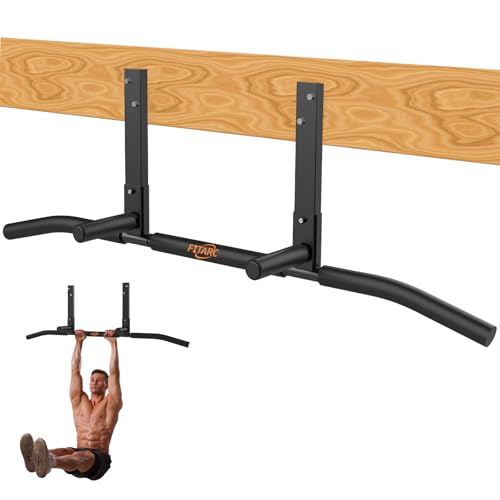
- Designed for wooden beams
- 440-pound listed capacity
- Padded multi-grip handles
Best For: Basement and garage gyms with suitable joists
Best Value Wall Mounted Pull Up Bar
Yes4All Wall Mounted Pull Up Bar

- Heavy-gauge steel with black powder coating
- Multiple padded grip positions
- Supports up to 300 pounds
Best For: Straightforward home upper-body workouts
Best Multifunctional Wall Mounted Pull Up Bar

- Integrated pulley system with cable attachments
- Multiple grip layouts and resistance-band hooks
- Supports up to 450 pounds when mounted securely
Best For: Expanded home cable and pull-up workouts
Best High-Capacity Wall Mounted Pull Up Bar

- 500-pound stated maximum capacity
- 19-inch and 27-inch adjustable depth
- Dual steel rings for added exercises
Best For: Heavy-duty and advanced bodyweight training
Best for Grip Variety
Kipika Multifunctional Wall Pull-Up Bar

- Five grip positions plus a ball-finger grip
- Steel construction with a listed 440-pound capacity
- Supports pull-ups, muscle-ups, leg raises and bands
Best For: Grip-focused and CrossFit-style home workouts
Best for Solid-Wall Mounting
MEDETAYI Wall-Mounted Pull-Up Bar

- Four grip positions for upper-body training
- Dual-triangular steel frame with a listed 500-pound capacity
- Includes two suspension attachment points
Best For: Concrete- or brick-wall home gyms
Best for Full-Body Training
CRYSTAL FIT Pull-Up and Dip Station

- Combines pull-up bar and dip station functions
- Padded back and arm supports improve workout comfort
- Designed for concrete or brick mounting with suspension anchors
Best For: Full-body home workouts with dips and core exercises
Best Overall Versatility – OneTwoFit Multifunctional Wall Pull Up Bar
For shoppers comparing wall mounted pull up bars, the OneTwoFit combines pull-ups, chin-ups, dips, push-ups, and leg raises in one wall-mounted station. Its heavy-duty steel frame is rated for up to 440 pounds, but installation requires a suitable concrete or brick wall.
Best For: Home gyms seeking a multifunctional upper-body and core workout station.
Pros:
- Supports up to 440 pounds with heavy-duty steel construction.
- Offers pull-up, chin-up, dip, push-up, and leg-raise exercises.
- Padded back and arm cushions improve comfort during ab and dip exercises.
Cons:
- Not suitable for drywall, plaster, or cavity walls.
- Requires a hammer drill and 12 mm bit for concrete or brick installation.
This is a strong all-in-one choice when exercise variety matters, provided your wall can safely handle the required anchors and mounting setup.
Best for Heavy-Duty Training – SELEWARE 48-Inch Wall Pull Up Bar
The SELEWARE is one of the more robust wall mounted pull up bars for users who want multiple grip options and a high listed capacity. Its 48-inch bar is designed to mount to compatible wood studs or concrete, while the end anchors add options for suspension work or a heavy bag.
Best For: Strength training setups that need a wide bar, varied grips, and attachment points.
Pros:
- 4 mm alloy-steel construction is rated to support up to 500 pounds.
- Multiple grips accommodate wide, narrow, neutral-grip, and chin-up exercises.
- End anchors support suspension training, resistance exercises, or a heavy bag.
Cons:
- The 48-inch width requires suitable stud spacing or a compatible concrete surface.
- Its listed item weight is 12 kg, so installation may require careful handling.
Choose this model when a wide, welded bar and attachment versatility are more important than an integrated dip station or padded back support.
Best Budget-Friendly Station – Multifunctional Wall Pull Up Bar
This multifunctional station gives wall mounted pull up bars added exercise range with pull-up, chin-up, dip, leg-raise, and boxing capabilities. It uses heavy-duty steel, four strong hooks, and non-slip grips, with a listed capacity of up to 440 pounds.
Best For: Compact home gyms wanting several bodyweight exercises from one wall-mounted unit.
Pros:
- Supports up to 440 pounds according to the supplied specifications.
- Combines pull-ups, chin-ups, dips, leg raises, and boxing.
- Includes eight concrete anchors and is designed for straightforward assembly.
Cons:
- Installation is limited to solid concrete, brick, or solid tile surfaces.
- It should not be installed on drywall, hollow brick, honeycomb brick, or sandwich panels.
This model suits buyers who want broad exercise functionality without separate equipment, as long as they have an approved solid mounting surface.
Best for Joist Installation – Fitarc Joist Mount Pull Up Bar
The Fitarc takes a different approach to wall mounted pull up bars by mounting to wooden beams, making it useful for basement and garage gyms. Its compact dual-support steel structure provides pull-up, chin-up, and hanging leg-raise capability while padded foam grips help reduce hand fatigue.
Best For: Home gyms with suitable wooden joists or beams and limited wall space.
Pros:
- Designed for installation on wooden beams in basement or garage setups.
- Supports pull-ups, chin-ups, hanging leg raises, and general upper-body training.
- Thickened foam handles provide padded, anti-slip gripping comfort.
Cons:
- It is listed as a ceiling- or joist-mounted product rather than a conventional wall mount.
- Installation depends on having compatible wooden beams.
This is a practical space-saving option for beam-based installations, but it is less suitable if you specifically need a standard concrete-wall pull-up bar.
Best Value Wall Mounted Pull Up Bar – Yes4All Wall Mounted Pull Up Bar
For shoppers seeking straightforward wall mounted pull up bars, the Yes4All model focuses on durable steel construction, multiple grip positions, and a relatively simple installation package. It supports up to 300 pounds and is designed for 16-inch and 24-inch stud spacing.
Best For: Home users who want a basic, multi-grip pull-up bar for upper-body strength training.
Pros:
- Heavy-gauge alloy steel construction with black powder coating for rust and corrosion resistance.
- Multiple padded grip positions support pull-ups, chin-ups, and varied upper-body training.
- Includes mounting hardware and instructions, plus a 30-day return period and one-year warranty.
Cons:
- Its 300-pound maximum capacity is lower than the other options in this roundup.
- Installation needs to match compatible 16-inch or 24-inch stud spacing.
The Yes4All is a practical choice when you want essential pull-up functionality without a more complex pulley system or adjustable frame. Confirm your wall and stud layout before ordering.
Best Multifunctional Wall Mounted Pull Up Bar – LIONSCOOL Pulley Pull-Up Bar
LIONSCOOL Multifunctional Wall Mounted Pull Up Bar with Pulley System (48" APART)
Check Price On AmazonThe LIONSCOOL stands out among wall mounted pull up bars by combining a 48-inch multi-grip chin-up bar with an integrated pulley system. Its included cables, loading pins, straight bar, tricep rope, and handles support more exercises than a standard pull-up station.
Best For: Users building a broader home upper-body routine with pull-ups, pulldowns, pushdowns, and cable exercises.
Pros:
- Integrated pulley system supports lat pulldowns, tricep pushdowns, cable flys, and more.
- Includes multiple cable attachments and resistance-band hooks for added training options.
- Heavy-gauge steel construction supports up to 450 pounds when securely mounted.
- Offers multiple grip layouts, diamond knurling, and a two-year warranty.
Cons:
- Its 30-pound weight and expanded attachments make it more involved than a basic pull-up bar.
- Recommended mounting surfaces are concrete or solid brick; drywall requires added wooden support.
This is the most versatile option here, but its pulley hardware and mounting requirements deserve careful planning. Use the included templates and verify that your wall can support the installation.
Best High-Capacity Wall Mounted Pull Up Bar – Jusgym Adjustable Chin-Up Bar
For shoppers comparing high-capacity wall mounted pull up bars, this Jusgym model offers a reinforced steel frame, a 500-pound stated capacity, and two adjustable depth positions. The 19-inch setting is suited to compact spaces, while the 27-inch setting allows more room for advanced movements.
Best For: Users who need a heavy-duty bar with adjustable wall clearance for standard and advanced bodyweight exercises.
Pros:
- 500-pound maximum capacity with reinforced steel construction and industrial-grade bolts.
- Adjustable 19-inch or 27-inch depth accommodates different spaces and movement styles.
- Includes dual steel rings for resistance-band, boxing, and gymnastic-ring training.
- Supports pull-ups, chin-ups, leg raises, and core exercises.
Cons:
- The extended 27-inch setting requires additional clearance from the wall.
- Installation is limited to suitable solid concrete or wooden wall structures.
The adjustable depth and high stated capacity make this a compelling option for users progressing beyond standard pull-ups. Measure your available clearance and confirm the wall structure before installation.
Best for Grip Variety – Kipika Multifunctional Wall Pull-Up Bar
If you want wall mounted pull up bars that support varied grip and CrossFit-style training, the Kipika offers five hand positions, including a distinctive ball-finger grip. Its steel frame is designed for solid-wall or wood-beam installation and leaves 6 inches of space from the wall for a fuller range of motion.
Best For: Adults who want grip-focused training, pull-ups, chin-ups, muscle-ups, leg raises and resistance-band exercises in a home gym.
Pros:
- Five grip positions, including wide, narrow, neutral, hammer and ball-finger grips
- Ball-finger grip supports finger-strength and endurance training
- Steel construction with a listed 440-pound support capacity and six-hole mounting design
- Foam handles and included mounting hardware add comfort and installation convenience
Cons:
- Requires a structurally sound wall or wood beam for installation
- The multi-handle design may require more wall width than a basic straight bar
The Kipika stands out for exercise variety and specialized grip work. It is a practical choice for users who want more than standard pull-ups, provided the installation surface can support the bar securely.
Best for Solid-Wall Mounting – MEDETAYI Wall-Mounted Pull-Up Bar
Among wall mounted pull up bars, this MEDETAYI model is aimed at users creating a permanent workout station on concrete or brick. It offers four grip positions, reinforced steel support and two integrated suspension anchors, but careful measurement and wall preparation are essential before installation.
Best For: Home-gym users with solid concrete or brick walls who want pull-up, chin-up and suspension-training options without using floor space.
Pros:
- Four grip positions support pull-ups, chin-ups and upper-body training
- Dual-triangular steel support structure is designed for stable everyday use
- Two suspension anchors accommodate compatible bands and suspension straps
- Powder-coated steel and high-density foam handles are suited to regular workouts
Cons:
- Not designed for direct mounting to drywall or other unsupported surfaces
- Buyers need to verify dimensions, bracket size and mounting-hole spacing before ordering
- Installation requires drilling and careful checking of all fasteners
This bar makes the most sense when you have a suitable masonry wall and want anchor points for additional accessories. Confirm the mounting area and included hardware before starting installation.
Best for Full-Body Training – CRYSTAL FIT Pull-Up and Dip Station
If you want wall mounted pull up bars that do more than pull-ups, the CRYSTAL FIT combines a chin-up bar with a dip station and padded back and arm supports. It is built for exercises such as dips, leg raises, push-ups and core work, with mounting intended for concrete or brick walls.
Best For: Users seeking a wall-mounted station for combined upper-body and core workouts, including chin-ups, dips and leg raises.
Pros:
- Combines pull-up, chin-up and dip-station functions in one unit
- Padded back and arm cushions improve comfort during supported exercises
- Heavy-duty steel construction has a listed 440-pound maximum capacity
- Includes assembly instructions, an assembly tool and two strong suspension anchors
Cons:
- Installation is limited to suitable concrete or brick walls; drywall, plaster and cavity walls are excluded
- The multifunction design is larger and heavier than a basic pull-up bar
- Assembly and secure wall mounting are required before use
Choose this model if a broader exercise selection matters more than a minimal footprint. Its integrated padding and dip station make it better suited to full-body routines than simple pull-up-only equipment.
How We Picked the Best Wall Mounted Pull Up Bars
We focused on the factors that matter most when choosing equipment for a home gym: construction quality, stated weight capacity, mounting design, grip variety, usable clearance, included attachments, and the range of exercises each station supports. We also considered whether a bar suits a dedicated training space, a compact room, or a setup that needs cable and dip functionality.
Installation is especially important. A wall-mounted bar is only as secure as the structure and hardware supporting it, so product specifications should be checked against your wall type, stud spacing, ceiling height, and available projection from the wall.
Quick Comparison
| Best For | Look For |
|---|---|
| Basic pull-up training | A rigid frame with comfortable multi-position grips |
| Full-body home workouts | Dip handles, chin-up positions, and accessory compatibility |
| Cable exercises | A pulley system with suitable attachments and smooth routing |
| Small rooms | A compact projection and a mounting layout that fits available studs |
| Heavier users | A clearly stated capacity and reinforced steel construction |
Key Buying Factors for Wall Mounted Pull-Up Bars
Mounting and Wall Compatibility
Confirm that the bar can be anchored to structural studs, masonry, or another approved surface. Avoid relying on drywall alone. Measure stud spacing, mounting-plate dimensions, and the distance from the wall before ordering.
Capacity and Stability
Look for a published weight rating that comfortably exceeds your body weight plus any added load. A wider mounting plate, multiple anchor points, and thick steel supports generally improve stability, but correct installation remains essential.
Grip Options and Clearance
Multiple grips can reduce wrist strain and support pull-ups, chin-ups, neutral-grip repetitions, and wider-back training. Also check bar height, handle diameter, padding, and clearance behind and above the station.
Versatility
Some wall mounted pull-up bars include dip handles, vertical supports, or pulley attachments. These features can expand training options, but they also require more wall space and may add installation complexity.
Who Should Buy Which Wall Mounted Pull Up Bars?
Choose a straightforward multi-grip bar if pull-ups and chin-ups are your priority and you want the simplest installation. Choose a dip-station model if you want one wall setup for upper-body pushing and pulling movements. Choose a pulley-equipped option if cable rows, triceps work, and adjustable resistance are important to your routine.
For limited spaces, measure carefully and favor a compact design with enough clearance for safe movement. For frequent weighted training, prioritize reinforced construction, a generous capacity rating, and a wall structure capable of handling dynamic loads. Regardless of the model, inspect bolts and brackets regularly and stop using the station if any movement, cracking, or hardware loosening appears.