Running builds endurance, but targeted strength work can help support power, stability, and overall training balance. The right adjustable dumbbells make that work easier to fit into a home routine without requiring a full rack of weights.
We compared these 10 options by adjustment range, portability, storage, handling, and suitability for runner-focused exercises such as split squats, rows, presses, and single-leg work.
Best 10 Adjustable Dumbbells for Runners Picks for 2026
Space-Saving Starter
Lifepro Quick-Adjust Dumbbells

- 5–25 lb range with 2.5 lb increments
- Compact pair replaces multiple fixed weights
- Textured grip and locking mechanism
Best For: Runners wanting moderate-weight, space-saving strength equipment
Versatile Progression Pick
BowFlex Results Series SelectTech

- 5–52.5 lb range per dumbbell
- Replaces 15 separate weights
- Includes trays and ergonomic non-slip handles
Best For: Runners planning to progress across light and heavy strength work
Grip-Focused Value Set
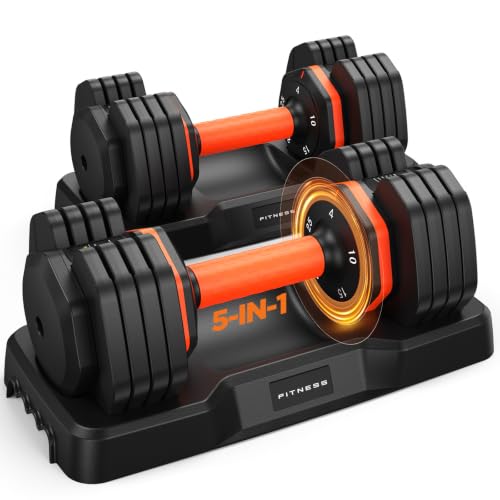
- 4–25 lb range across five settings
- 33mm textured silicone grip
- Dual-lock design and storage box
Best For: Runners prioritizing quick adjustments and secure handling
Heavy-Strength Upgrade
Nuobell 580 Adjustable Dumbbells

- 5–80 lb range per dumbbell
- One-twist adjustment in 5 lb increments
- Knurled handles, trays, and four-year warranty
Best For: Runners combining training with serious long-term strength progression
Heavy-Duty Choice
Eisenlink Quick-Lock Adjustable Dumbbells

- 10–80 lb per dumbbell in 5-lb increments
- Cast-iron construction with secure plate fit
- No storage base required
Best For: Runners wanting substantial weight progression for full-body strength work
Balanced Home-Gym Pick
Core Fitness TwistLock Dumbbells

- 5–50 lb per dumbbell
- One-handed TwistLock adjustments
- Compact design with soft-grip handles
Best For: Runners prioritizing convenient changes and compact home storage
Fine-Tuning Pick
WLR Micro-Increment Adjustable Dumbbells

- 3–25 lb per dumbbell across 10 settings
- Small increments support gradual progression
- One-hand dial with base-tray safety interlock
Best For: Runners focusing on lighter work and precise load increases
Most Versatile
UNNMIIY 5-in-1 Adjustable Dumbbell Set

- Converts for dumbbell, barbell, kettlebell, and push-up exercises
- 2–22.5 lb adjustable range per dumbbell
- Textured handles and upgraded locking nuts
Best For: Runners wanting varied full-body strength workouts from one set
Best for Progressive Training
Yagud 12-in-1 Adjustable Dumbbells

- 12 increments from 4 to 50 pounds
- One-handed rotation for quick weight changes
- Tray-activated safety lock and textured handles
Best For: Runners doing progressive strength work, circuits, or HIIT
Best Compact Option
Poudee 3-in-1 Adjustable Dumbbells

- Three light weight levels from 2.2 to 5 pounds per pair
- Quick 45-degree adjustment with dual locking
- Anti-roll design uses less than 0.2 square feet
Best For: Runners needing portable, light resistance for small spaces or travel
Space-Saving Starter – Lifepro Quick-Adjust Dumbbells
For runners adding strength work at home, the Lifepro adjustable dumbbells offer a compact way to train without keeping a full rack nearby. The pair adjusts from 5 to 25 pounds in 2.5-pound increments, making it practical to scale exercises such as lunges, rows, presses, and curls.
Best For: Runners who want a compact, moderate-weight pair for full-body home workouts.
Pros:
- Quick-adjust dial moves between 5 and 25 pounds in 2.5-pound increments.
- Pair replaces multiple fixed-weight dumbbells and saves floor space.
- Textured non-slip grip and locking mechanism support stable training.
- Alloy steel construction and access to Lifepro workout resources.
Cons:
- 25-pound maximum per dumbbell may limit heavier strength progression.
- The supplied configuration is a pair, so storage and total weight are greater than with a single dumbbell.
This is a straightforward choice for runners who prioritize convenience and space efficiency over very heavy loading. Its smaller adjustment steps are useful when building strength gradually alongside a running routine.
Versatile Progression Pick – BowFlex Results Series SelectTech
The BowFlex Results Series SelectTech dumbbells suit runners who want more room to progress from lighter accessory work to challenging presses, rows, and lower-body exercises. Quick-adjust dials provide settings from 5 to 52.5 pounds per dumbbell while the pair replaces 15 separate weights.
Best For: Runners seeking a broad weight range and a premium, space-saving pair for long-term home training.
Pros:
- Adjusts from 5 to 52.5 pounds per dumbbell with quick-turn dials.
- Replaces 15 separate weights and includes storage trays.
- Metal components and a locking system help keep weights in place.
- Ergonomic, non-slip handle and two months of JRNY access are included.
Cons:
- The set weighs 110.6 pounds overall, so it is less convenient to move frequently.
- The supplied details identify target body parts primarily as arms and shoulders rather than a dedicated running-specific program.
With its wide range, this pair can support both lighter runner-focused strength sessions and heavier general training. It is a strong fit when adjustability and progression matter more than the lowest possible equipment weight.
Grip-Focused Value Set – FDB2 25-Pound Adjustable Pair
For runners who value quick transitions and a secure grip, this FDB2 adjustable pair offers five settings from 4 to 25 pounds. The included storage box and silicone grip make it suited to compact home sessions involving lunges, presses, rows, and other supplemental exercises.
Best For: Runners wanting an affordable-feeling, grip-focused pair for efficient home strength circuits.
Pros:
- One-hand adjustment switches among five weights from 4 to 25 pounds.
- 33mm textured silicone grip is designed to reduce slipping during sweaty sessions.
- Dual-lock system adjusts on the base and locks plates when lifted.
- Cast-iron plates with a PE exterior and a storage box are included.
Cons:
- 25-pound maximum per dumbbell provides less headroom than heavier options.
- The five available weight settings offer less fine adjustment than the Lifepro’s 2.5-pound increments.
- The product notes mention a one-year after-sale promise while also describing lifetime service, so support terms may warrant verification.
This set emphasizes fast handling and grip security, useful qualities when fitting strength training around running. Choose it if its 25-pound ceiling matches your needs and you prefer a storage box over a larger weight setup.
Heavy-Strength Upgrade – Nuobell 580 Adjustable Dumbbells
The Nuobell 580 is aimed at runners who want a complete strength option that can continue well beyond basic accessory work. Its pair adjusts from 5 to 80 pounds in 5-pound increments with a one-twist handle, while included trays help keep the substantial set organized.
Best For: Runners who also want heavy, long-term home strength training capability.
Pros:
- Wide 5–80-pound range per dumbbell supports substantial progression.
- One-twist adjustment makes transitions quick between exercises.
- 5-pound increments provide predictable progression from beginner to advanced loads.
- Steel-knurled handles provide a non-slip, gym-style grip, and a four-year warranty is included.
Cons:
- The pair weighs 80 pounds, making it a heavy setup to transport or reposition.
- 5-pound increments are less precise than smaller adjustment steps for lighter exercises.
- The 19-inch length may feel bulky for some movements compared with lighter adjustable designs.
This is the most capable option here for runners who want strength equipment that can grow with them. Its heavy range is more than many running-focused routines require, but it offers substantial versatility for a broader home gym.
Heavy-Duty Choice – Eisenlink Quick-Lock Adjustable Dumbbells
For runners who want adjustable dumbbells for runners that can support both lighter accessory work and heavier strength sessions, the Eisenlink pair offers a broad 10-to-80-pound range per dumbbell. Its cast-iron construction and plate-based design make it a substantial home-gym option, though the adjustment process takes a little practice.
Best For: Runners seeking a wide weight range for progressive full-body strength training.
Pros:
- Adjusts from 10 to 80 pounds per dumbbell in 5-pound increments.
- Cast-iron construction has no plastic or fragile parts.
- Does not require a storage base and includes knurled grips.
- Plate snap design helps keep the weights fitted securely during exercise.
Cons:
- Unscrewing and tightening both ends takes some practice.
- The 80-pound pair weighs 160 pounds in total and is relatively large.
- The pair ships in two separate packages.
This is the most expandable option of the three, making it suitable when running strength work may progress from modest accessory loads to demanding compound exercises. Its heavier, more manual design is less convenient if you prioritize rapid changes between exercises.
Balanced Home-Gym Pick – Core Fitness TwistLock Dumbbells
The Core Fitness pair is a practical choice for runners looking for adjustable dumbbells for runners with straightforward, quick weight changes. TwistLock technology lets you adjust each dumbbell from 5 to 50 pounds with one hand while it rests in its cradle, and the compact design suits limited home-gym space.
Best For: Runners who value quick adjustments, a comfortable grip, and compact storage.
Pros:
- Offers 5-to-50-pound adjustments for each dumbbell.
- TwistLock technology allows one-handed weight changes in the cradle.
- Contoured, textured, soft-grip handles support comfortable control.
- Compact design provides a traditional dumbbell feel while saving space.
Cons:
- Weight changes require the included cradle.
- Its maximum setting is lower than the Eisenlink pair’s 80 pounds per dumbbell.
For most running-focused home workouts, the 5-to-50-pound range should cover common strength movements without taking over the room. Choose this set if convenient transitions and handle comfort matter more than maximum loading.
Fine-Tuning Pick – WLR Micro-Increment Adjustable Dumbbells
These WLR dumbbells stand out for runners who want adjustable dumbbells for runners with smaller jumps between loads. Each dumbbell offers 10 settings from 3 to 25 pounds, with one-hand adjustment and a safety interlock designed to prevent lifting the dumbbell when the dial is between settings.
Best For: Runners doing lighter accessory training or gradually increasing load in small increments.
Pros:
- Provides 10 settings from 3 to 25 pounds per dumbbell.
- Starts at a useful 3-pound setting and uses smaller progression steps.
- One-hand adjustment changes weights in about one second according to the product notes.
- Base-tray interlock helps prevent lifting when the dial is not properly set.
Cons:
- 25 pounds per dumbbell is the lowest maximum range among these options.
- The adjustment system uses a base tray.
- The supplied details list a single unit count despite describing a pair.
This set is particularly appealing for controlled progression, shoulder work, and lighter running-support exercises where a 5- or 10-pound jump may be too large. Runners planning heavy lower-body strength training may outgrow its 25-pound-per-dumbbell limit.
Most Versatile – UNNMIIY 5-in-1 Adjustable Dumbbell Set
For runners adding strength work to their routine, the UNNMIIY set offers adjustable dumbbells for runners along with several training configurations. The detachable plates provide a single-dumbbell range of 2 to 22.5 pounds, while the included connector can convert the set for barbell, kettlebell, and push-up exercises.
Best For: Runners who want one home-gym set for strength training, presses, squats, kettlebell movements, and push-ups.
Pros:
- 5-in-1 design supports dumbbell, barbell, kettlebell, and push-up-stand use.
- Adjustable single-dumbbell range accommodates different training stages.
- Textured handles and upgraded locking nuts help support grip and plate stability.
- Foam-covered connector is designed for a softer, sweat-absorbing grip.
Cons:
- Changing configurations requires attaching or removing components.
- The supplied details list several set weights, so buyers should confirm the selected version before ordering.
This is a practical pick for runners who want more exercise variety than a standard dumbbell pair provides. Its multi-function setup is useful for building a compact home gym, though it may be more equipment than needed for simple accessory exercises.
Best for Progressive Training – Yagud 12-in-1 Adjustable Dumbbells
The Yagud set is a strong option for runners seeking adjustable dumbbells for runners that can support progressive overload. Its one-handed rotation mechanism moves between 4 and 50 pounds across 12 increments, making it easier to adjust resistance between circuits, lunges, and upper-body exercises.
Best For: Runners who want broad weight selection and quick transitions for circuits, HIIT, or structured strength sessions.
Pros:
- Offers 12 weight increments from 4 to 50 pounds.
- One-handed rotation allows quick adjustments without manually changing plates.
- Safety lock restricts adjustment to the included tray to help prevent plate movement.
- Textured, slip-resistant handles support grip during sweaty workouts.
Cons:
- Its listed 109-pound item weight may be substantial for some home users.
- The larger listed dimensions require more storage space than ultra-compact hand weights.
With its wide resistance range and fast adjustment system, this set suits runners who treat strength training as a regular part of their program. The tray-based locking design adds a useful safety feature, while the size may be less appealing for very small spaces.
Best Compact Option – Poudee 3-in-1 Adjustable Dumbbells
For runners who need portable equipment, the Poudee set keeps adjustable dumbbells for runners small and easy to store. It provides three weight levels—2.2, 3.6, and 5 pounds per pair—and uses a quick 45-degree rotation system with dual-locking plates for light strength, mobility, or rehabilitation-focused sessions.
Best For: Runners who prefer light resistance for travel, office workouts, warm-up routines, or space-limited home training.
Pros:
- Three adjustable weight levels fit in one compact set.
- 45-degree rotation adjustment is designed for quick changes.
- Dual-lock mechanism helps keep plates secure during use.
- Square anti-roll design uses less than 0.2 square feet of storage space.
Cons:
- The light weight range is less suitable for heavy lower-body strength training.
- Only three adjustment levels are listed.
This is the most convenient choice of the three for runners prioritizing portability and low-impact accessory work. Its light resistance can complement running without adding much equipment bulk, but stronger athletes may outgrow the available loading range.
How We Picked the Best Adjustable Dumbbells for Runners
We focused on the features that matter when dumbbells need to complement running rather than replace a complete strength-training setup. Each option was considered for weight range, adjustment increments, ease of changing loads, grip and handling, storage footprint, and overall versatility.
For runners, useful dumbbells should support both lighter accessory work and progressively heavier movements. We also considered whether a set is practical for small spaces, quick sessions, travel between rooms, and workouts that alternate frequently between exercises.
Quick Comparison
| What to Compare | Why It Matters |
|---|---|
| Weight range | Determines whether the set works for both lighter upper-body exercises and heavier lower-body movements. |
| Adjustment system | Fast changes are helpful for circuits and workouts with frequent exercise transitions. |
| Increments | Smaller steps make it easier to progress gradually and avoid unnecessary jumps in load. |
| Storage design | A compact tray, case, or integrated base helps keep plates organized and floors clear. |
| Handle and balance | A secure, comfortable grip supports controlled repetitions and single-arm movements. |
Key Buying Factors for Adjustable Dumbbells for Runners
Choose a Useful Starting Weight
Most runners need moderate loads for movements such as Romanian deadlifts, goblet squats, step-ups, rows, and loaded carries. A very broad range is valuable only if the set remains easy to handle at lighter settings.
Prioritize Smooth Adjustments
If you plan to use dumbbells in circuits, look for a mechanism that changes quickly and locks securely. A slower system may be acceptable for traditional sets with longer rest periods, but it can interrupt interval-style strength sessions.
Check Size and Balance
Adjustable designs can become longer or wider than fixed dumbbells, especially at lower weights. Confirm that the shape will not interfere with presses, lunges, or movements where the dumbbell rests near your legs.
Match Durability to Your Training
For controlled home workouts, many designs can work well. If you regularly drop weights, perform high-volume sessions, or train heavily, verify the manufacturer’s handling guidance and avoid assuming every adjustable set is suitable for impact.
Who Should Buy Which Adjustable Dumbbells for Runners?
New runners and beginners: Choose a set with lighter starting options and small increments so you can learn strength movements and progress conservatively.
Experienced runners: A wider range and faster adjustment system are more useful if you combine strength circuits, heavier lower-body work, and different training phases.
Small-space users: Prioritize compact storage and a design that replaces several fixed pairs without taking over a room.
Travelers or occasional lifters: Look for a manageable case or storage box, straightforward setup, and a weight range that covers your most common exercises rather than the heaviest advertised setting.
Before buying, confirm the exact weight range, whether the listed price covers one dumbbell or a pair, available increments, warranty terms, and the manufacturer’s instructions for adjustment and use.