The best slant boards for squats can make heel elevation more consistent during squats while also supporting calf stretching, ankle-mobility work, and lower-body warmups. The right design depends on your preferred incline, available space, and the loads you plan to use.
We selected 10 options ranging from compact fixed wedges to adjustable boards and stackable angle systems. Use the guide below to compare construction, stability, portability, and fit before choosing one for your training setup.
Best 10 Slant Boards for Squats Picks for 2026
Best Adjustable Pick
StrongTek Adjustable Wooden Slant Board

- Five incline settings from 15° to 35°
- Full anti-slip surface and side carry handle
- Useful for squats, stretching, and rehab
Best For: Adjustable home-gym and recovery training
Best Heavy-Duty Pair
1800-Lb Wooden Squat Wedge Blocks

- 1,800-pound stated weight capacity
- 15° angle with textured grip surfaces
- Includes bag and training poster
Best For: Weighted squats and portable mobility work
Best Wide Platform
StrongTek 25° Wooden Squat Board

- 19.6-inch-wide surface for natural stance
- Fixed 25° incline for consistent training
- 1,000-pound capacity with dual non-slip grip
Best For: Stable, wide-stance heel-elevated squats
Best Portable Silicone Pair

- 15° bevel with side height markings
- 1,500-pound stated load capacity
- Includes bag, poster, and guide
Best For: Portable heel-elevated squats and mobility work
Best Adjustable Steel-Frame Pick

- Five incline settings from 15° to 40°
- 660-pound alloy-steel frame capacity
- Textured, foldable platform with no assembly
Best For: Home users wanting broad angle adjustability and sturdy daily support
Best Split-Stance Design
EXURA Wide Dual-Platform Slant Board

- Two independent metal foot platforms
- Four incline levels for squats and stretching
- 900-pound capacity with rubber grip surfaces
Best For: Lifters needing asymmetric angles, wider stances, or split-squat support
Best Guided Wooden Option
Portable Five-Angle Calf Stretch Board
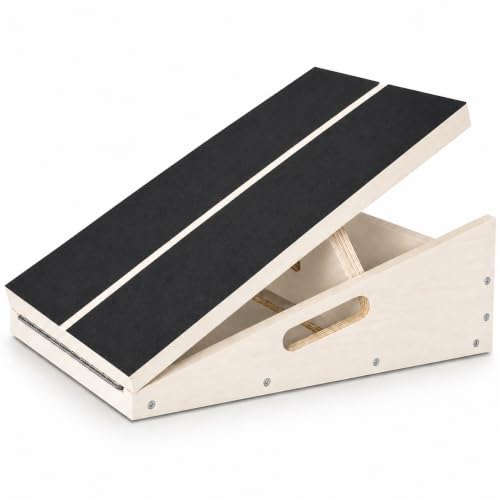
- Five settings from 15° to 35°
- 500-pound wooden construction capacity
- Carry handle, exercise guide, and three-year warranty
Best For: Beginners wanting guided, portable squat and mobility training
Heavy-Duty Pick

- Wide 19.7-inch hardwood platform
- Rated for up to 1,000 pounds
- Full-grip surface with handling holes
Best For: Heavy-duty squats, calf stretching, and ATG training
Best Simple Pick

- Four incline settings from 30° to 45°
- Weighs about 5 pounds
- Suitable for exercise and rehabilitation
Best For: Portable, adjustable stretching and squat sessions
Modular Foam Pick

- Three wedges create five angle setups
- Lightweight high-density EPP material
- Works for squats, stretching, and step-ups
Best For: Versatile, adjustable wedge-based workouts
Best Adjustable Pick – StrongTek Adjustable Wooden Slant Board
For shoppers comparing slant boards for squats, the StrongTek Wooden Slant Board stands out for its adjustable incline and full wooden platform. Five angle settings from 15° to 35° let you tailor heel elevation for squats, calf stretching, ankle mobility work, and rehabilitation exercises.
Best For: Users who want adjustable angles, a full-size platform, and a board that can also support stretching and recovery routines.
Pros:
- Five adjustable positions: 15°, 20°, 25°, 30°, and 35°.
- Full-coverage anti-slip treads help provide traction during use.
- Hardwood plywood construction with a side handle for portability.
- No assembly required.
Cons:
- At about 9 pounds, it is heavier than compact wedge pairs.
- The larger platform may be less convenient for travel than portable squat wedges.
This is a versatile choice if you want one slant board for squats plus calf stretching and rehab-focused movements. Its adjustable design offers more setup flexibility than fixed-angle options.
Best Heavy-Duty Pair – 1800-Lb Wooden Squat Wedge Blocks
These squat wedge blocks are a practical option for shoppers seeking slant boards for squats with a high stated load capacity. The 15° wooden wedges elevate the heels for barbell, Smith, and Bulgarian squats while also working as calf stretchers and ankle-mobility tools.
Best For: Lifters who prefer a pair of compact, full-foot wedges for weighted squats, mobility work, and gym portability.
Pros:
- Stated 1,800-pound weight capacity.
- 15° incline supports heel-elevated squats and ankle-mobility training.
- Textured PVC tops and non-slip bases provide added grip.
- Includes a pair of wedges, carrying bag, and training poster.
Cons:
- The fixed 15° angle offers less adjustment than an adjustable board.
- With two separate blocks, foot placement may require more setup than a single platform.
The pair format gives each foot dedicated support and makes the wedges easy to transport. Choose this model when a fixed angle, high load rating, and included carrying accessories matter most.
Best Wide Platform – StrongTek 25° Wooden Squat Board
For users who find narrow slant boards for squats restrictive, this StrongTek model provides a 19.6-inch-wide surface for a more natural stance. Its fixed 25° incline supports heel-elevated squats, split squats, calf raises, and lower-body mobility exercises.
Best For: Athletes and home-gym users who want a wide, stable single board for shoulder-width squatting and repeated strength training.
Pros:
- Extra-wide 19.6-inch platform accommodates a natural squat stance.
- Fixed 25° incline provides consistent heel elevation.
- Hardwood plywood construction and three-point support are rated for up to 1,000 pounds.
- Textured top and anti-slip base strips help with grip and floor protection.
Cons:
- The incline is not adjustable.
- Its non-foldable, 7.7-pound design takes more storage space than compact wedges.
This board is especially appealing when footroom and platform stability are higher priorities than portability or angle adjustment. The wide surface can make heel-elevated lower-body exercises feel less cramped.
Best Portable Silicone Pair – 1500-Lb Non-Slip Squat Wedges
These compact squat wedges suit shoppers looking for portable slant boards for squats with full-foot support. Their 15° ergonomic bevel raises the heels for deep squats, weightlifting, calf stretches, and ankle-mobility work, while side markings help identify the wedge height.
Best For: Users who want a lightweight pair of non-slip wedges for home, gym, or on-the-go lower-body training.
Pros:
- Stated 1,500-pound load capacity.
- Silicone, leaf-textured surfaces are designed for grip.
- Full-foot dimensions measure 11.8 by 5.9 inches.
- Includes a pair, carrying bag, training poster, and instruction guide.
Cons:
- The 15° angle is fixed rather than adjustable.
- Separate wedges may provide less continuous stance space than a wide single board.
This set balances portability, grip, and a strong stated capacity. It is a sensible pick for lifters who want heel elevation without carrying a larger wooden platform.
Best Adjustable Steel-Frame Pick – Five-Angle Wooden Slant Board
For shoppers comparing slant boards for squats, this model combines a reinforced alloy-steel frame with a wooden platform and five incline settings. Its broad, textured surface is designed for squat practice, heel raises, calf stretching, and ankle-mobility work.
Best For: Home-gym users who want multiple angle options and a firm, ready-to-use platform.
Pros:
- Five settings from 15 to 40 degrees support gradual progression.
- Steel frame is rated for loads up to 660 pounds.
- 12 x 15.7-inch textured platform provides room for foot placement.
- Folds for storage and requires no assembly.
Cons:
- At 7.4 pounds, it is heavier than some compact boards.
- The supplied details do not specify an exercise guide.
This is a versatile choice if you want one adjustable board for squat preparation, calf work, and mobility drills. The steel foundation and foldable design make it especially practical for regular home use.
Best Split-Stance Design – EXURA Wide Dual-Platform Slant Board
Among slant boards for squats, the EXURA stands out for its two independent metal platforms. Separate foot supports allow asymmetric angles and wider stances, while four incline levels cover squat-wedge work, calf stretching, and ankle mobility.
Best For: Lifters who need independent foot positioning for split squats, wide stances, or heel-elevated squat training.
Pros:
- Independent platforms accommodate asymmetric foot angles and wider stances.
- Four incline levels support progressive stretching and squat practice.
- Rubber top grips and base mats are designed to limit slipping.
- Metal construction is rated for up to 900 pounds.
Cons:
- The dual-platform layout may feel less familiar than a single board.
- The compact 13.78 x 7.28-inch dimensions provide less continuous surface area.
- No assembly or carry-handle feature is listed in the supplied details.
The EXURA is the specialized option in this group. Its independent platforms make it a strong fit for varied foot positions and split-stance training, while the high capacity suits heavier users.
Best Guided Wooden Option – Portable Five-Angle Calf Stretch Board
This wooden option gives shoppers looking for slant boards for squats five angle settings, a textured top, and a slip-resistant base. It is built for squat practice as well as calf stretching, ankle mobility, warmups, and controlled strength work.
Best For: Beginners and home users who value a carry handle, exercise guidance, and gradual angle progression.
Pros:
- Five settings from 15 to 35 degrees suit different flexibility levels.
- 500-pound capacity supports stretching, calf raises, and squat practice.
- Textured standing surface and slip-resistant base promote stable contact.
- Side handle, visual exercise guide, and three-year warranty add convenience.
Cons:
- Its 3.85 kg weight is less portable than an ultralight design.
- The maximum angle is 35 degrees, lower than some five-angle alternatives.
This board is a practical all-around pick for users who want a traditional wooden platform with clear setup guidance. The handle and exercise guide make it particularly approachable for home, gym, or office use.
Heavy-Duty Pick – EVERYMATE Wooden Slant Board
If you want slant boards for squats that prioritize a wide, sturdy platform, this EVERYMATE model is built from hardwood plywood and rated for up to 1,000 pounds. Its full sandpaper surface and raised non-slip baffle are designed to keep feet more secure during heel-elevated squats, calf stretches, and mobility work.
Best For: Lifters who want a wide, durable wooden board for squats, calf stretching, ATG training, and rehabilitation exercises.
Pros:
- Wide 19.7-inch platform with a stated 1,000-pound weight capacity
- Full anti-slip tread and baffle help reduce foot movement
- Wood construction, bottom ribbed panels, and built-in handling holes
- Supports squats, lunges, balance training, stretching, and physical therapy movements
Cons:
- Offers one listed level rather than adjustable incline positions
- At 3.11 kg, it is heavier than some portable foam options
This is a strong choice when stability and a broad standing surface matter more than compact storage or adjustable angles. The assembled hardwood design also makes it suitable for regular home or gym use.
Best Simple Pick – Portable Wooden Slant Board
For shoppers comparing slant boards for squats, this portable wooden option stands out for its four adjustable incline positions: 30°, 35°, 40°, and 45°. It weighs about 5 pounds and is intended for stretching, weight-bearing exercise, physical therapy, and mobility work at home, in the office, or at a gym.
Best For: Beginners, athletes, and rehabilitation users who want multiple incline settings in a portable wooden board.
Pros:
- Four listed angle settings from 30° to 45°
- Lightweight design is easy to move between locations
- Suitable for calf stretching, squats, Pilates, and physical therapy
- Designed for a wide range of ages and fitness levels
Cons:
- Its listed dimensions are smaller than the wide EVERYMATE board
- The supplied notes do not state a maximum weight capacity
The adjustable design makes this a flexible pick for users who want to change the challenge or accommodate different stretching needs. Its portability is especially useful when the board will be used in more than one setting.
Modular Foam Pick – Stackable Squat Wedge Set
This set takes a modular approach to slant boards for squats, using two 8.5° wedges and one 17° wedge to create several configurations. The high-density EPP blocks can support heel-elevated squats, calf stretching, calf raises, step-ups, and some physical therapy routines while remaining lightweight.
Best For: Users who want stackable wedges with multiple angles and extra workout versatility beyond a single slant board.
Pros:
- Three-piece system offers five stackable angle configurations
- High-density EPP is lightweight and designed to retain its shape
- Silicone grip points help improve floor contact
- Can be used for squats, stretching, calf raises, step-ups, and cardio routines
Cons:
- Wedge-style pieces provide less continuous surface area than a full board
- The supplied details do not specify the exact angle of every configuration
- Optional strap availability may vary by version
This is the most versatile format of the three, particularly for people who want to vary angles or repurpose the equipment for step-ups and cardio. Choose it over a solid board if modularity and low weight are priorities.
How We Picked the Best Slant Boards for Squats
We compared these Slant Boards for Squats by focusing on the features that affect everyday use: angle options, platform width, weight capacity, traction, materials, portability, and versatility. Fixed wedges can be simple and stable, while adjustable models offer more flexibility for squats, calf stretches, and mobility drills. We also considered whether each design appears suited to home gyms, weight rooms, rehabilitation exercises, or travel.
Capacity ratings are useful, but they should not be treated as a substitute for stability. A board must remain planted and comfortable under your stance, especially when used with dumbbells, barbells, or a loaded machine.
Quick Comparison
- Best for adjustability: Choose a multi-angle board if you want to change heel elevation for different exercises or mobility levels.
- Best for a simple setup: A fixed wooden wedge offers quick setup with fewer moving parts.
- Best for wider stances: Look for a broad platform, particularly if you squat with a larger stance or use both feet together.
- Best for portability: Compact boards with handles or lighter construction are easier to store and carry.
- Best for varied mobility work: Stackable wedge sets provide several angles without requiring a hinged adjustment mechanism.
Key Buying Factors for Slant Boards for Squats
Angle and Adjustability
A higher incline can make heel elevation more noticeable, while a lower angle may feel more natural for beginners or calf stretching. Adjustable models let you fine-tune the position as your ankle mobility changes.
Stability and Traction
Prioritize a non-slip top and a base that sits firmly on your floor. Rubberized contact points or textured surfaces can help reduce sliding, but always test the board unloaded before using heavy weights.
Width, Length, and Capacity
Check the platform dimensions against your shoe size and squat stance. A longer or wider board can feel more secure, while the stated weight rating should comfortably exceed your body weight plus any equipment.
Construction and Storage
Wooden boards are often sturdy and easy to use, while steel-reinforced designs may appeal to higher-load users. Handles, foldable features, or compact dimensions matter if the board must be stored between sessions.
Who Should Buy Which Slant Boards for Squats?
Beginners and mobility-focused users should consider a stable fixed wedge or a low-angle adjustable board that is easy to position. Strength trainees who squat frequently may prefer a wide, high-capacity platform with dependable traction. Users combining squats and calf stretching will benefit from adjustable or multi-angle options. Traveling athletes and physical-therapy users should prioritize lighter boards, carry handles, and straightforward setup. Before training, inspect the board for damage and place it on a clean, level surface to reduce the risk of movement.