A ceiling-mounted pull-up bar can turn unused overhead space into a reliable strength-training station, but the right model must match your joist layout, ceiling height, available clearance, and preferred grip positions.
This roundup compares 10 strong options, including adjustable, multi-grip, wide-bar, and heavy-duty designs, so you can choose a bar that fits your training goals and installation needs.
Best 10 Ceiling Mounted Pull Up Bars Picks for 2026
Flexible Joist Fit
Ultimate Body Press Reversible-Riser Bar

- Fits 16-inch and 24-inch joists
- Four angled grip positions
- Includes installation template and hardware
Best For: Flexible home-gym placement and varied pull-up workouts
Adjustable Training Hub
Kipika 32-Inch Ceiling Pull-Up Bar

- Four height settings and adjustable angle
- 400-pound maximum weight recommendation
- Hooks for straps, ropes, and punching bags
Best For: Multi-purpose ceiling-mounted home gyms
Wide 8-Foot Ceiling Fit
Ultimate Body Press 48-Inch Bar
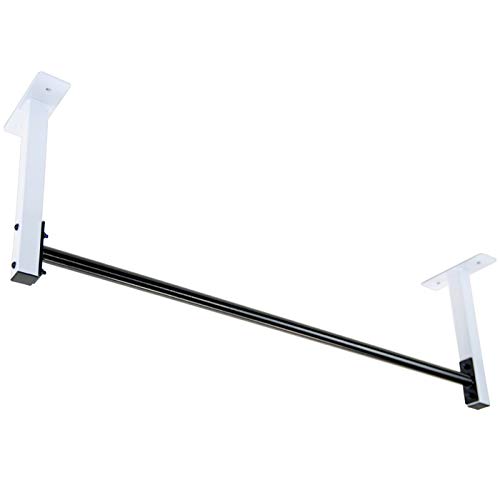
- Designed for 8-foot ceilings
- 48-inch straight pull-up bar
- Fits common 16-inch and 24-inch joist spacing
Best For: Wide, stable pull-up training in lower-ceiling rooms
Heavy-Duty Capacity

- 800-pound maximum weight recommendation
- Multi-grip monkey-style design
- Reversible frame with powder-coated finish
Best For: Heavy-duty bodybuilding and powerlifting-style workouts
Most Versatile
Adjustable Multi-Grip Ceiling Pull-Up Bar

- Five grip positions include a ball finger grip
- Four height settings for varied users and exercises
- Supports up to 400 pounds and accepts training accessories
Best For: Home gyms needing adjustable height and expanded grip-based training
Best Multi-Grip Design
Titan Fitness Ceiling Pull-Up Bar

- Offers traditional, narrow, angled, and neutral grips
- 33 mm knurled handles provide textured contact
- 50-inch-wide powder-coated steel frame
Best For: Users wanting a sturdy fixed bar with multiple grip orientations
Best for Joist Mounting
Shnlie 42-Inch Ceiling Pull-Up Bar

- Designed for wood beams, joists, or rafters
- 440-pound stated weight capacity
- Six foam pads support a comfortable, non-slip grip
Best For: Home gyms with accessible wood joists, beams, or rafters
Versatile Adjustable Pick

- Five grip styles for varied pull-up training
- Five-position height adjustment
- 300-pound maximum weight recommendation
Best For: Home gym users seeking grip variety and adjustable clearance
Most Flexible Mounting
ATENTO Reversible-Riser Pull-Up Bar

- Mounts to ceilings, joists, beams, walls, or doorways
- Padded foam grips
- 400-pound maximum weight recommendation
Best For: Versatile installations and higher-capacity training
Highest Capacity Option
Kipika Adjustable 500-Pound Bar

- Adjustable height from 25.8 to 41 inches
- Eight-hole design for added stability
- 500-pound maximum weight recommendation
Best For: Strength training where high capacity and vertical adjustment matter
Flexible Joist Fit – Ultimate Body Press Reversible-Riser Bar
This ceiling mounted pull up bar is designed to move workouts away from the wall while fitting either 16-inch or 24-inch joists. Its reversible risers and multiple grip positions make it a practical choice for home gyms where placement flexibility matters.
Best For: Home-gym users who want adjustable joist compatibility, varied pull-up grips, and an anchor point for optional bodyweight accessories.
Pros:
- Reversible risers accommodate 16-inch and 24-inch joists.
- Four angled grip positions support varied pull-up training.
- Includes mounting template, hardware, instructions, and USA tech support.
- Rated for up to 300 pounds and backed by a 10-year limited warranty.
Cons:
- Optional resistance trainers are sold separately.
- Its 42-inch width may provide less room than wider straight-bar models.
The reversible mounting design is the main advantage here, especially if your ceiling framing or future workout layout may change. It offers a well-rounded setup for standard bodyweight training without taking up wall space.
Adjustable Training Hub – Kipika 32-Inch Ceiling Pull-Up Bar
This ceiling mounted pull up bar combines adjustable height and bar angles with accessory hooks for broader home-gym use. It is built for users who want one ceiling setup for pull-ups, resistance-band work, suspension training, or a punching bag.
Best For: Multi-purpose home gyms needing adjustable positioning and attachment points for training accessories.
Pros:
- Supports up to 400 pounds.
- Four height settings accommodate different ceiling and installation requirements.
- Two hooks can hold suspension straps, ropes, yoga straps, or a boxing bag.
- Mounting holes suit 16-inch and 32-inch stud spacing, with hardware for wood and concrete mounting.
Cons:
- The 32-inch width is narrower than several bar options in this roundup.
- Its broad accessory focus may be more than needed for basic pull-ups.
With height adjustment, angle changes, and dual accessory hooks, the Kipika is the most multifunctional option here. Confirm your ceiling material and stud layout before installation to ensure the included mounting approach matches your space.
Wide 8-Foot Ceiling Fit – Ultimate Body Press 48-Inch Bar
This ceiling mounted pull up bar is tailored to rooms with 8-foot ceilings, using 14-inch risers and a 48-inch straight bar. Its mounting plates are designed for common 16-inch and 24-inch residential joist spacing, while the through-bolted construction is intended to limit bar rotation.
Best For: Home gyms with 8-foot ceilings that need a wide, stable straight bar and broad joist compatibility.
Pros:
- 48-inch bar provides ample room for upper-body and core exercises.
- 48-inch on-center mounting plates fit typical 16-inch and 24-inch joist layouts.
- Through-bolted steel risers help reduce rotation under load.
- Rated for up to 450 pounds with a 10-year limited warranty.
Cons:
- The 14-inch risers are specifically suited to 8-foot ceilings and may not fit every room layout.
- Ab straps and gymnastic rings are optional accessories.
This model stands out for combining a wide straight bar with a ceiling height specification that suits many lower-ceiling rooms. Its mounting design and through-bolted bar make it a strong candidate when stability and full-range positioning are priorities.
Heavy-Duty Capacity – Gronk Fitness Multi-Grip Bar
This ceiling mounted pull up bar is built around a broad multi-grip design and a high stated weight capacity. Its reversible frame can be adjusted to suit the available space, while the powder-coated finish is intended to help resist rust.
Best For: Users prioritizing a heavy-duty multi-grip bar for bodybuilding and powerlifting-style home workouts.
Pros:
- Rated to support up to 800 pounds.
- Monkey-style multi-grip layout supports varied hand positions.
- Reversible frame helps adapt the installation to your space.
- Lifetime residential warranty is listed for the product.
Cons:
- Its 29-pound weight may make installation more demanding.
- The mounting holes are 48 inches apart, so ceiling framing must match that layout.
- Accessories beyond the bar, mounts, and hardware are not listed as included.
The Gronk Fitness bar is the capacity-focused choice, with the highest stated maximum weight among these ceiling mounted pull up bars. Its wide, multi-grip frame suits demanding training, but verify the 48-inch mounting span and ceiling structure before buying.
Most Versatile – Adjustable Multi-Grip Ceiling Pull-Up Bar
For shoppers comparing ceiling mounted pull up bars, the SELEWARE stands out for its adjustable height, varied grip options, and heavy-duty steel construction. It supports up to 400 pounds and is designed for mounting to wood or concrete ceilings with compatible stud spacing.
Best For: Home gyms needing adjustable height and expanded grip-based training options.
Pros:
- Five grip positions, including a ball finger grip for specialized grip-strength training.
- Four height settings accommodate different users and exercises.
- Heavy-duty steel construction with a four-hole design and 400-pound capacity.
- Includes rings for attaching suspension straps, bands, and other accessories.
Cons:
- The maximum supported weight is listed as 400 pounds, despite another product highlight mentioning 500 pounds.
- Installation requires suitable ceiling studs or a compatible concrete surface.
This is a strong choice when versatility matters most. Its adjustable design and accessory rings make it more adaptable than a basic fixed bar, while the included mounting hardware supports a broad range of installation setups.
Best Multi-Grip Design – Titan Fitness Ceiling Pull-Up Bar
The Titan Fitness bar is a practical option among ceiling mounted pull up bars for users who want several traditional and neutral grip positions in a fixed ceiling-mounted setup. Its powder-coated alloy steel frame extends 16 inches from the ceiling and includes knurled handles for a secure hold.
Best For: Users who want a sturdy fixed bar with multiple grip orientations.
Pros:
- Supports traditional, narrow, angled, and neutral-grip pull-ups.
- Knurled 33 mm handles provide a textured grip.
- Powder-coated steel construction is designed for durability.
- Includes expansion bolts for ceiling installation.
Cons:
- It has a fixed 16-inch extension rather than adjustable height.
- Installation requires drilling and appropriate ceiling mounting points.
- At 50 inches wide and 35 pounds, it may require careful handling during installation.
Choose this model if grip variety is more important than adjustability. The 50-inch width and multiple handle orientations provide a broad training platform, while the fixed design keeps the setup straightforward.
Best for Joist Mounting – Shnlie 42-Inch Ceiling Pull-Up Bar
For buyers seeking ceiling mounted pull up bars that attach directly to wood beams or rafters, the Shnlie offers a 42-inch-wide bar with a stated 440-pound capacity. Its steel construction, foam-padded handles, and installation accessories make it suited to a dedicated home-gym mounting point.
Best For: Home gyms with accessible wood joists, beams, or rafters.
Pros:
- Heavy-duty steel construction supports up to 440 pounds.
- Designed for installation on wood beams, joists, or rafters.
- Six foam pads provide an anti-slip, wear-resistant grip surface.
- Includes instructions, installation accessories, and helpful installation videos.
Cons:
- The supplied details specify wood installation, so it may be less suitable for concrete ceilings.
- The listing details identify the mount type as wall mount, which may require verifying the intended ceiling installation before purchase.
- It does not offer the height-adjustment feature found on some competing models.
This bar is worth considering when your workout space has a suitable exposed or accessible wood mounting structure. Verify the installation requirements and mounting orientation carefully, then its 42-inch width and 440-pound rating provide a capable fixed pull-up station.
Versatile Adjustable Pick – Kipika 48-Inch Multi-Grip Bar
For shoppers comparing ceiling mounted pull up bars, the Kipika stands out for its five grip styles and adjustable support-arm height. It offers a flexible setup for home gyms, garages, basements, or other suitable indoor and outdoor mounting locations.
Best For: Users who want multiple pull-up variations and adjustable clearance in a ceiling-mounted setup.
Pros:
- Five grip options include wide, narrow, neutral, chin-up, and hammer grips.
- Support arms adjust through five positions, with 18- to 26-inch distance from the mounting surface.
- Powder-coated metal is designed to resist rust and scratches.
- Rated for up to 300 pounds and supplied with mounting screws.
Cons:
- Installation requires suitable mounting surfaces and correctly positioned studs.
- Its 48-inch mounting-hole spacing may not suit every ceiling layout.
This is a practical choice when grip variety and moderate adjustability matter most. Confirm the ceiling structure and mounting dimensions before installation.
Most Flexible Mounting – ATENTO Reversible-Riser Pull-Up Bar
The ATENTO is a flexible option among ceiling mounted pull up bars, with reversible risers that support ceiling, joist, beam, wall, or doorway installation. Its padded grips and 400-pound capacity make it suited to demanding home-gym and functional-training setups.
Best For: Users who need several mounting options and a high stated weight capacity.
Pros:
- Reversible risers can be positioned for ceiling, joist, beam, wall, or doorway mounting.
- One-piece heavy-gauge steel construction is coated to help resist rust and corrosion.
- High-density foam grips are designed to be thick, wear-resistant, waterproof, and slip-resistant.
- Supports up to 400 pounds and includes mounting hardware, tools, and instructions.
Cons:
- The 40-inch-wide frame may require more installation clearance than narrower bars.
- Its broad mounting flexibility still depends on having a suitable structural mounting point.
Choose the ATENTO if installation flexibility is a priority or if you prefer padded grips. Review the mounting instructions and verify the chosen surface can support the intended use.
Highest Capacity Option – Kipika Adjustable 500-Pound Bar
For shoppers seeking ceiling mounted pull up bars with substantial load support, this Kipika model combines adjustable height with an eight-hole mounting design. Its height range is intended to accommodate different ceiling heights and exercise preferences.
Best For: Strength-focused users who prioritize a high stated weight capacity and adjustable vertical clearance.
Pros:
- Adjusts from 25.8 to 41 inches to suit different exercise spaces.
- Eight-hole design is intended to improve stability and security.
- Heavy steel construction with an electrophoretic coating helps resist rust and corrosion.
- Rated for up to 500 pounds and includes mounting hardware for a standard joist.
Cons:
- The 41-inch maximum height requires substantial overhead clearance.
- Installation is specified for a standard joist, so mounting compatibility should be checked first.
This Kipika is the strongest-capacity option in this group on paper, while its adjustable height adds setup flexibility. Confirm joist placement, available clearance, and installation requirements before buying.
How We Picked the Best Ceiling Mounted Pull Up Bars
We focused on the features that matter most for safe, repeatable home workouts: mounting compatibility, construction, grip design, adjustability, usable width, installation practicality, and versatility. The selected bars include models designed for standard joist spacing, beams, rafters, and other suitable structural mounting points.
We also considered whether each design supports different exercises, such as pull-ups, chin-ups, neutral-grip work, hanging core movements, resistance-band training, or accessory use. A bar with more features is not automatically better; the best choice depends on your ceiling structure, body size, training style, and available room.
Quick Comparison
| Feature | What to compare | Best for |
|---|---|---|
| Grip layout | Straight, multi-grip, neutral, or knurled handles | Exercise variety and hand comfort |
| Mounting design | Joist, beam, rafter, or ceiling-specific hardware | Matching your structure |
| Width and riser height | Bar span plus distance from the ceiling | Clearance and comfortable range of motion |
| Adjustability | Reversible risers or multiple height positions | Adapting to different ceilings |
| Extra attachment points | Band, bag, or accessory compatibility | More varied home-gym workouts |
Key Buying Factors for Ceiling Mounted Pull Up Bars
Confirm the Mounting Surface
Ceiling-mounted pull-up bars should attach to structural framing, not drywall or unsupported ceiling material. Measure joist spacing before ordering, and verify whether the mounting plate and included hardware suit your joists, beams, or rafters. If the spacing does not match, use an appropriately engineered mounting solution rather than improvising.
Check Clearance and Bar Height
Measure floor-to-ceiling height, your body length, and the space above and around the bar. Riser height affects head clearance, knee position, and whether you can perform a full dead hang comfortably. Leave enough room for controlled movement without contacting the ceiling, walls, lights, or storage.
Choose the Right Grip Style
A straight bar is simple and versatile, while multi-grip and neutral handles can reduce wrist strain or add exercise variety. Knurled metal may provide a secure grip but can feel rough; foam or padded grips may be more comfortable but can wear sooner with heavy use.
Evaluate Construction and Installation
Look for substantial steel components, solid welds, dependable fasteners, and clear installation instructions. Check the manufacturer’s stated capacity, but remember that dynamic movements create more force than a static bodyweight hang. Tighten and inspect the mount regularly.
Who Should Buy Which Ceiling Mounted Pull Up Bars?
Choose an adjustable or reversible-riser model if your joist spacing or ceiling height requires flexibility. A wide, straight-bar design suits users who want a familiar pull-up setup and more room for varied hand positions. Multi-grip bars are better for households sharing one station or lifters who want chin-ups and neutral-grip variations. Heavy-duty welded models appeal to frequent users who prioritize rigid construction. If you want broader home-gym functionality, consider a model with band or punching-bag attachment support—but only when the added accessory does not compromise your required clearance or mounting strength.